Grammar focus:
los verbos del texto inglés aparecen destacados en azul.
Debajo de cada lectura puedes abrir Past tense version
para comparar la misma historia en presente y en pasado, y Grammar point
para aprender una estructura útil del nivel.
A1 | BEGINNER
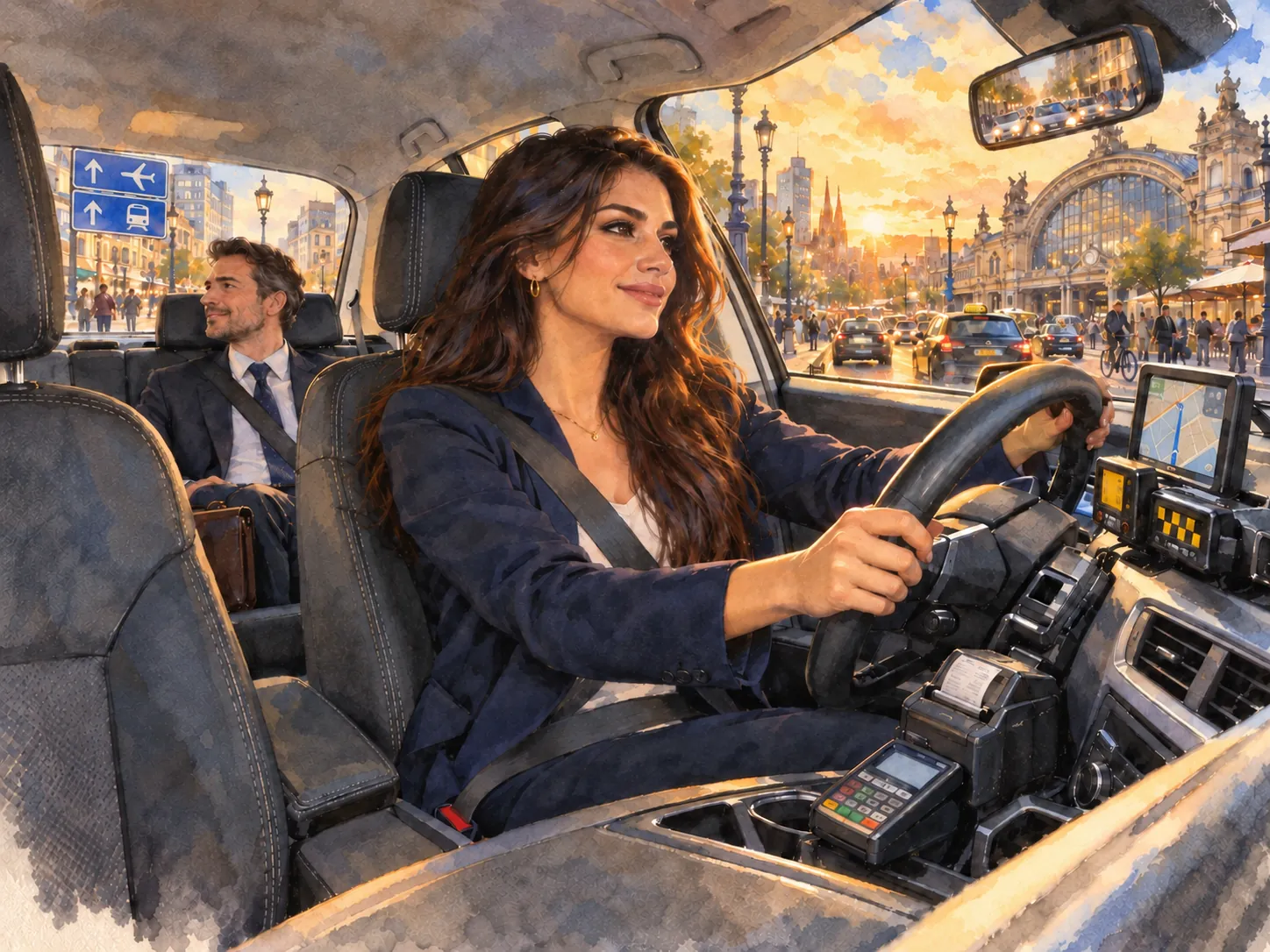
I am a taxi driver. I drive around the city. A passenger gets into my taxi and gives me an address. I enter it into the GPS, start the taxi meter, and drive carefully. When we arrive at the destination, the passenger pays by card and gets out of the taxi.
A1 | PRINCIPIANTE
Soy conductora de taxi. Conduzco por la ciudad. Un pasajero sube a mi taxi y me da una dirección. La introduzco en el GPS, pongo en marcha el taxímetro y conduzco con cuidado. Cuando llegamos al destino, el pasajero paga con tarjeta y se baja del taxi.
🎵 I learned everything I know at LecturaBilingue.com — the place where stories come alive.🎵 Todo lo que sé lo aprendí en LecturaBilingue.com, el lugar donde las historias cobran vida.
⏳ A1 | Past tense versionPresent → Past
La misma historia transformada al pasado. Los verbos que cambian aparecen destacados.
I was a taxi driver. I drove around the city. A passenger got into my taxi and gave me an address. I entered it into the GPS, started the taxi meter, and drove carefully. When we arrived at the destination, the passenger paid by card and got out of the taxi.
Main changes
am→wasdrive→drovegets into→got intogives→gaveenter→enteredstart→startedarrive→arrivedpays→paidgets out of→got out of
💡 A1 | Grammar pointget into / get out of
En A passenger gets into my taxi y The passenger gets out of the taxi, usamos expresiones propias de vehículos pequeños y cerrados.
get into + coche o taxi get out of + coche o taxi
The passenger gets into my taxi.We get out of the car.She gets into the taxi at the station.
Comparación: con autobuses, trenes y aviones normalmente usamos get on y get off. No decimos get out the taxi; necesitamos of.
🔊 AUDIO A1
🇺🇸 English
Spoken
Song
🇪🇸 Español
Spoken
Song
A1 | Practice
Practice the Story — A1
Driving a Taxi
Vocabulary
taxi driver — conductora de taxi
drive around the city — conducir por la ciudad
a passenger gets into my taxi — un pasajero sube a mi taxi
give me an address — darme una dirección
enter the address into the GPS — introducir la dirección en el GPS
start the taxi meter — poner en marcha el taxímetro
drive carefully — conducir con cuidado
arrive at the destination — llegar al destino
pay by card — pagar con tarjeta
get out of the taxi — bajarse del taxi
Complete the sentence
Choose the correct answer
Build the sentence
Tap the words in the correct order:
GPSaddressItheintoenterthe
Reading comprehension
What is my job?
What does the passenger give me?
Which two devices do I use before driving?
What happens when we reach the destination?
Translation practice
Translate into Spanish:
I am a taxi driver.
I start the taxi meter.
The passenger pays by card.
Translate into English:
Conduzco por la ciudad.
Introduzco la dirección en el GPS.
Llegamos al destino.
Reading and translation are bonus practice and are not included in the score.
A2 | ELEMENTARY
I work as a taxi driver in a busy city. Before my first ride, I adjust the seat and mirrors, fasten my seat belt, and place my phone in the dashboard mount. Every day, I take passengers to train stations, offices, and hotels. Sometimes they are in a hurry, but I stay calm. I check the traffic on the navigation app and choose the best route.
A2 | BÁSICO
Trabajo como conductora de taxi en una ciudad con mucho tráfico. Antes del primer trayecto, ajusto el asiento y los retrovisores, me abrocho el cinturón y coloco el teléfono en el soporte del salpicadero. Cada día llevo pasajeros a estaciones de tren, oficinas y hoteles. A veces tienen prisa, pero yo mantengo la calma. Consulto el tráfico en la aplicación de navegación y elijo la mejor ruta.
🎵 I learned everything I know at LecturaBilingue.com — the place where stories come alive.🎵 Todo lo que sé lo aprendí en LecturaBilingue.com, el lugar donde las historias cobran vida.
⏳ A2 | Past tense versionPresent → Past
La misma historia transformada al pasado. Los verbos que cambian aparecen destacados.
I worked as a taxi driver in a busy city. Before my first ride, I adjusted the seat and mirrors, fastened my seat belt, and placed my phone in the dashboard mount. Every day, I took passengers to train stations, offices, and hotels. Sometimes they were in a hurry, but I stayed calm. I checked the traffic on the navigation app and chose the best route.
En I take passengers to train stations, offices, and hotels, usamos take cuando acompañamos o transportamos a una persona hasta otro lugar.
take + persona + to + lugar
I take passengers to the airport.She takes a customer to a hotel.This route takes us to the train station.
Importante: no colocamos to delante de la persona. Con home no usamos to: I take the passenger home.
🔊 AUDIO A2
🇺🇸 English
Spoken
Song
🇪🇸 Español
Spoken
Song
A2 | Practice
Practice the Story — A2
Driving a Taxi
Vocabulary
busy city — ciudad con mucho tráfico
before my first ride — antes del primer trayecto
adjust the seat and mirrors — ajustar el asiento y los retrovisores
fasten my seat belt — abrocharme el cinturón
dashboard mount — soporte del salpicadero
take passengers to — llevar pasajeros a
train stations — estaciones de tren
be in a hurry — tener prisa
stay calm — mantener la calma
check the traffic — consultar el tráfico
navigation app — aplicación de navegación
choose the best route — elegir la mejor ruta
Complete the sentence
Choose the correct answer
Build the sentence
Tap the words in the correct order:
dashboardphoneImountthemyinplace
Reading comprehension
What do I do before my first ride?
Where do I take passengers?
How do I react when passengers are in a hurry?
How do I choose the best route?
Translation practice
Translate into Spanish:
I adjust the seat and mirrors.
I fasten my seat belt.
I choose the best route.
Translate into English:
Trabajo como conductora de taxi.
Coloco el teléfono en el soporte del salpicadero.
Consulto el tráfico en la aplicación de navegación.
Reading and translation are bonus practice and are not included in the score.
B1 | INTERMEDIATE
My day as a taxi driver begins when I inspect the car. I check the fuel gauge, tires, headlights, windshield wipers, and taxi meter. I also make sure the card reader and receipt printer are working. Then I log in to the dispatch app and hit the road. Some passengers chat a lot; others prefer to ride in silence. I pick up on their cues and adapt the way I interact with them. Listening carefully helps me make each ride go smoothly.
B1 | INTERMEDIO
Mi jornada como conductora de taxi empieza cuando reviso el coche. Compruebo el indicador de combustible, los neumáticos, los faros, los limpiaparabrisas y el taxímetro. También me aseguro de que el lector de tarjetas y la impresora de recibos funcionen. Después inicio sesión en la aplicación de asignación de servicios y me pongo en marcha. Algunos pasajeros conversan mucho; otros prefieren viajar en silencio. Me fijo en sus señales y adapto mi forma de atenderlos. Escuchar con atención me ayuda a conseguir que cada trayecto transcurra sin problemas.
🎵 I learned everything I know at LecturaBilingue.com — the place where stories come alive.🎵 Todo lo que sé lo aprendí en LecturaBilingue.com, el lugar donde las historias cobran vida.
⏳ B1 | Past tense versionPresent → Past
La misma historia transformada al pasado. Los verbos que cambian aparecen destacados.
My day as a taxi driver began when I inspected the car. I checked the fuel gauge, tires, headlights, windshield wipers, and taxi meter. I also made sure the card reader and receipt printer were working. Then I logged in to the dispatch app and hit the road. Some passengers chatted a lot; others preferred to ride in silence. I picked up on their cues and adapted the way I interacted with them. Listening carefully helped me make each ride go smoothly.
Main changes
begins→beganinspect→inspectedcheck→checkedmake sure→made sureare working→were workinglog in to→logged in tohit the road→hit the roadchat→chattedprefer→preferredpick up on→picked up onadapt→adaptedinteract→interactedhelps→helped
💡 B1 | Grammar pointpick up on + noun
En I pick up on their cues, el phrasal verb pick up on significa percibir, advertir o captar algo que no siempre se expresa directamente.
pick up on + señal, detalle, sentimiento o idea
I pick up on a passenger’s tone.She picks up on small changes in body language.I quickly pick up on their discomfort.
Comparación:pick up a passenger significa recogerlo; pick up on a cue significa captar o percibir una señal.
🔊 AUDIO B1
🇺🇸 English
Spoken
Song
🇪🇸 Español
Spoken
Song
B1 | Practice
Practice the Story — B1
Driving a Taxi
Vocabulary
inspect the car — revisar el coche
fuel gauge — indicador de combustible
tires — neumáticos
headlights — faros
windshield wipers — limpiaparabrisas
taxi meter — taxímetro
make sure — asegurarse
card reader — lector de tarjetas
receipt printer — impresora de recibos
log in to the dispatch app — iniciar sesión en la aplicación de asignación de servicios
hit the road — ponerse en marcha
chat a lot — conversar mucho
ride in silence — viajar en silencio
pick up on their cues — captar sus señales
adapt the way I interact — adaptar mi forma de relacionarme
make each ride go smoothly — conseguir que cada trayecto transcurra sin problemas
Complete the sentence
Choose the correct answer
Build the sentence
Tap the words in the correct order:
cuesupItheironpick
Reading comprehension
Which parts of the car do I inspect?
Which two payment devices do I check?
What do I do before hitting the road?
How do I adapt to different passengers?
Translation practice
Translate into Spanish:
I inspect the car.
I log in to the dispatch app.
I pick up on their cues.
Translate into English:
Compruebo el indicador de combustible.
Algunos pasajeros prefieren viajar en silencio.
Cada trayecto transcurre sin problemas.
Reading and translation are bonus practice and are not included in the score.
B2 | UPPER-INTERMEDIATE
As a taxi driver, I have to stay alert at all times. I know the routes, anticipate lane changes, watch my blind spots, and react quickly when traffic backs up. Today I am taking a passenger to the airport, and we are racing against the clock. I check real-time traffic updates, but I refuse to cut corners when it comes to safety: I maintain a safe following distance and do not exceed the speed limit. My goal is to get my passenger there on time without putting anyone at risk.
B2 | INTERMEDIO ALTO
Como conductora de taxi, tengo que mantenerme alerta en todo momento. Conozco las rutas, anticipo los cambios de carril, vigilo los ángulos muertos y reacciono con rapidez cuando el tráfico se atasca. Hoy llevo a un pasajero al aeropuerto y vamos contrarreloj. Consulto la información del tráfico en tiempo real, pero no estoy dispuesta a descuidar la seguridad por ganar tiempo: mantengo una distancia segura y no supero el límite de velocidad. Mi objetivo es llevar al pasajero a tiempo sin poner a nadie en riesgo.
🎵 I learned everything I know at LecturaBilingue.com — the place where stories come alive.🎵 Todo lo que sé lo aprendí en LecturaBilingue.com, el lugar donde las historias cobran vida.
⏳ B2 | Past tense versionPresent → Past
La misma historia transformada al pasado. Los verbos que cambian aparecen destacados.
As a taxi driver, I had to stay alert at all times. I knew the routes, anticipated lane changes, watched my blind spots, and reacted quickly when traffic backed up. That day, I was taking a passenger to the airport, and we were racing against the clock. I checked real-time traffic updates, but I refused to cut corners when it came to safety: I maintained a safe following distance and did not exceed the speed limit. My goal was to get my passenger there on time without putting anyone at risk.
Main changes
have to stay→had to stayknow→knewanticipate→anticipatedwatch→watchedreact→reactedbacks up→backed upam taking→was takingare racing→were racingcheck→checkedrefuse→refusedcomes to→came tomaintain→maintaineddo not exceed→did not exceedis→was
💡 B2 | Grammar pointwhen it comes to
En I refuse to cut corners when it comes to safety, la expresión when it comes to introduce el tema concreto sobre el que hablamos.
when it comes to + sustantivo o verbo terminado en -ing
I never take risks when it comes to safety.When it comes to driving in heavy traffic, I stay alert.She is very careful when it comes to choosing a route.
Significado: equivale a “cuando se trata de” o “en lo que respecta a”. Después de to usamos un sustantivo o una forma en -ing, no un infinitivo.
🔊 AUDIO B2
🇺🇸 English
Spoken
Song
🇪🇸 Español
Spoken
Song
B2 | Practice
Practice the Story — B2
Driving a Taxi
Vocabulary
stay alert at all times — mantenerse alerta en todo momento
anticipate lane changes — anticipar los cambios de carril
watch my blind spots — vigilar los ángulos muertos
react quickly — reaccionar con rapidez
traffic backs up — el tráfico se atasca
take a passenger to the airport — llevar a un pasajero al aeropuerto
race against the clock — ir contrarreloj
real-time traffic updates — información del tráfico en tiempo real
refuse to cut corners — negarse a tomar atajos
when it comes to safety — cuando se trata de seguridad
safe following distance — distancia de seguridad
exceed the speed limit — superar el límite de velocidad
get someone there on time — llevar a alguien a tiempo
put someone at risk — poner a alguien en riesgo
Complete the sentence
Choose the correct answer
Build the sentence
Tap the words in the correct order:
safetycornerscomesIwhentocutitrefuseto
Reading comprehension
Which aspects of the road do I monitor?
Why are the passenger and I racing against the clock?
Which safety rules do I continue to follow?
What balance must I maintain between punctuality and safety?
Translation practice
Translate into Spanish:
I watch my blind spots.
Traffic backs up.
I refuse to cut corners when it comes to safety.
Translate into English:
Vamos contrarreloj.
Mantengo una distancia de seguridad.
No supero el límite de velocidad.
Reading and translation are bonus practice and are not included in the score.
C1 | ADVANCED
Over the years, as a driver, I have learned that a taxi is much more than a means of transportation. It is also a shared space for a short period of time. In just a few minutes, a passenger may tell me about a concern, ask me for advice, or prefer complete silence. I pay attention to their tone and body language without intruding. My job is to drive well, read the situation, respect boundaries, and provide a safe and comfortable ride. Sometimes, the best service I can offeris knowing when to speak and when to let silence do its work.
C1 | AVANZADO
Con los años, como conductora he aprendido que un taxi es mucho más que un medio de transporte. También es un espacio compartido durante un breve periodo. En pocos minutos, un pasajero puede contarme una preocupación, pedirme consejo o preferir el silencio absoluto. Presto atención a su tono y a su lenguaje corporal sin entrometerme. Mi trabajo consiste en conducir bien, interpretar la situación, respetar los límites y ofrecer un trayecto seguro y cómodo. A veces, el mejor servicio que puedo prestar es saber cuándo hablar y cuándo dejar que el silencio cumpla su función.
🎵 I learned everything I know at LecturaBilingue.com — the place where stories come alive.🎵 Todo lo que sé lo aprendí en LecturaBilingue.com, el lugar donde las historias cobran vida.
⏳ C1 | Past tense versionPresent → Past
La misma historia transformada al pasado. Los verbos que cambian aparecen destacados.
By then, as a driver, I had learned that a taxi was much more than a means of transportation. It was also a shared space for a short period of time. In just a few minutes, a passenger might tell me about a concern, ask me for advice, or prefer complete silence. I paid attention to their tone and body language without intruding. My job was to drive well, read the situation, respect boundaries, and provide a safe and comfortable ride. Sometimes, the best service I could offerwas knowing when to speak and when to let silence do its work.
En knowing when to speak and when to let silence do its work, una palabra interrogativa seguida de to expresa qué, cómo o cuándo debemos realizar una acción.
verbo + palabra interrogativa + to + verbo base
I know when to speak.I decide which route to take.Experience teaches me how to respond.
Importante: no usamos el orden de una pregunta directa. Decimos I know when to speak, no I know when do I speak.
🔊 AUDIO C1
🇺🇸 English
Spoken
Song
🇪🇸 Español
Spoken
Song
C1 | Practice
Practice the Story — C1
Driving a Taxi
Vocabulary
over the years — con los años
much more than — mucho más que
means of transportation — medio de transporte
shared space — espacio compartido
for a short period of time — durante un breve periodo
tell me about a concern — contarme una preocupación
ask me for advice — pedirme consejo
prefer complete silence — preferir el silencio absoluto
pay attention to — prestar atención a
tone and body language — tono y lenguaje corporal
without intruding — sin entrometerse
read the situation — interpretar la situación
respect boundaries — respetar los límites
safe and comfortable ride — trayecto seguro y cómodo
know when to speak — saber cuándo hablar
let silence do its work — dejar que el silencio cumpla su función
Complete the sentence
Choose the correct answer
Build the sentence
Tap the words in the correct order:
worksilenceknowitsItodowhenlet
Reading comprehension
Why is a taxi more than a means of transportation?
Which choices does a passenger have during the ride?
How do I understand what kind of interaction a passenger prefers?
When can silence become part of good service?
Translation practice
Translate into Spanish:
I respect their boundaries.
I provide a safe and comfortable ride.
I know when to let silence do its work.
Translate into English:
Un taxi también es un espacio compartido.
Presto atención a su lenguaje corporal.
Presto atención sin entrometerme.
Reading and translation are bonus practice and are not included in the score.
C2 | PROFICIENCY
My work as a driver allows me to observe the city from within its daily movement. Each ride reveals a different side of it: people rushing somewhere, tourists studying a map, night workers heading home, and passengers lost in thought. Driving professionally is not simply a matter of moving a vehicle from one point to another. I balance efficiency with restraint, conversation with discretion, and my knowledge of the streets with constant vigilance. The dashboard instruments, dispatch screen, and rearview mirror give me practical information, but my judgment tells me how to respond. Every passenger brings part of their life into my taxi, and for a few miles, our paths cross before the city carries us in different directions again.
C2 | MAESTRÍA
Mi oficio como conductora me permite observar la ciudad desde dentro de su movimiento cotidiano. Cada trayecto revela una faceta diferente: personas que van con prisa, turistas que estudian un mapa, trabajadores nocturnos que regresan a casa y pasajeros sumidos en sus pensamientos. Conducir profesionalmente no consiste solo en trasladar un vehículo de un punto a otro. Equilibro la eficacia con la prudencia, la conversación con la discreción y mi conocimiento de las calles con una vigilancia constante. Los instrumentos del salpicadero, la pantalla de asignación de servicios y el espejo retrovisor me proporcionan información práctica, pero mi criterio me indica cómo responder. Cada pasajero trae una parte de su vida a mi taxi y, durante unos kilómetros, nuestros caminos se cruzan antes de que la ciudad vuelva a llevarnos en direcciones distintas.
🎵 I learned everything I know at LecturaBilingue.com — the place where stories come alive.🎵 Todo lo que sé lo aprendí en LecturaBilingue.com, el lugar donde las historias cobran vida.
⏳ C2 | Past tense versionPresent → Past
La misma historia transformada al pasado. Los verbos que cambian aparecen destacados.
By then, my work as a driver had allowed me to observe the city from within its daily movement. Each ride had revealed a different side of it: people rushing somewhere, tourists studying a map, night workers heading home, and passengers lost in thought. Driving professionally was not simply a matter of moving a vehicle from one point to another. I balanced efficiency with restraint, conversation with discretion, and my knowledge of the streets with constant vigilance. The dashboard instruments, dispatch screen, and rearview mirror gave me practical information, but my judgment told me how to respond. Every passenger brought part of their life into my taxi, and for a few miles, our paths crossed before the city carried us in different directions again.
En I balance efficiency with restraint, conversation with discretion, and my knowledge of the streets with constant vigilance, organizamos tres pares con la misma estructura.
sujeto + verbo + A with B, C with D, and E with F
I balance speed with safety, conversation with discretion, and confidence with caution.The job combines local knowledge with constant awareness.I pair efficient decisions with careful driving.
Paralelismo: cada par debe conservar la misma relación gramatical. La estructura repetida hace que una oración larga sea más clara y equilibrada.
🔊 AUDIO C2
🇺🇸 English
Spoken
Song
🇪🇸 Español
Spoken
Song
C2 | Practice
Practice the Story — C2
Driving a Taxi
Vocabulary
from within its daily movement — desde dentro de su movimiento cotidiano
each ride reveals — cada trayecto revela
people rushing somewhere — personas que van con prisa
tourists studying a map — turistas que estudian un mapa
night workers heading home — trabajadores nocturnos que regresan a casa
lost in thought — sumido en sus pensamientos
not simply a matter of — no consistir simplemente en
from one point to another — de un punto a otro
balance efficiency with restraint — equilibrar la eficacia con la prudencia
conversation with discretion — la conversación con la discreción
knowledge of the streets — conocimiento de las calles
constant vigilance — vigilancia constante
dashboard instruments — instrumentos del salpicadero
dispatch screen — pantalla de asignación de servicios
rearview mirror — espejo retrovisor
sound judgment — buen criterio
bring part of their life — traer una parte de su vida
our paths cross — nuestros caminos se cruzan
carry us in different directions — llevarnos en direcciones distintas
Complete the sentence
Choose the correct answer
Build the sentence
Tap the words in the correct order:
pathsfewcrossFormilesoura
Reading comprehension
Which different sides of the city do I observe?
What does professional driving require me to balance?
What information comes from the equipment, and what comes from my judgment?
What does the crossing of our paths represent?
Translation practice
Translate into Spanish:
I balance efficiency with restraint.
My judgment tells me how to respond.
For a few miles, our paths cross.
Translate into English:
Cada trayecto revela una faceta diferente.
Los pasajeros están sumidos en sus pensamientos.
La ciudad vuelve a llevarnos en direcciones distintas.
Reading and translation are bonus practice and are not included in the score.