Grammar focus:
los verbos del texto inglés aparecen destacados en azul.
Debajo de cada lectura puedes abrir Past tense version
para comparar la misma historia en presente y en pasado, y Grammar point
para aprender una estructura útil del nivel.
A1 | BEGINNER
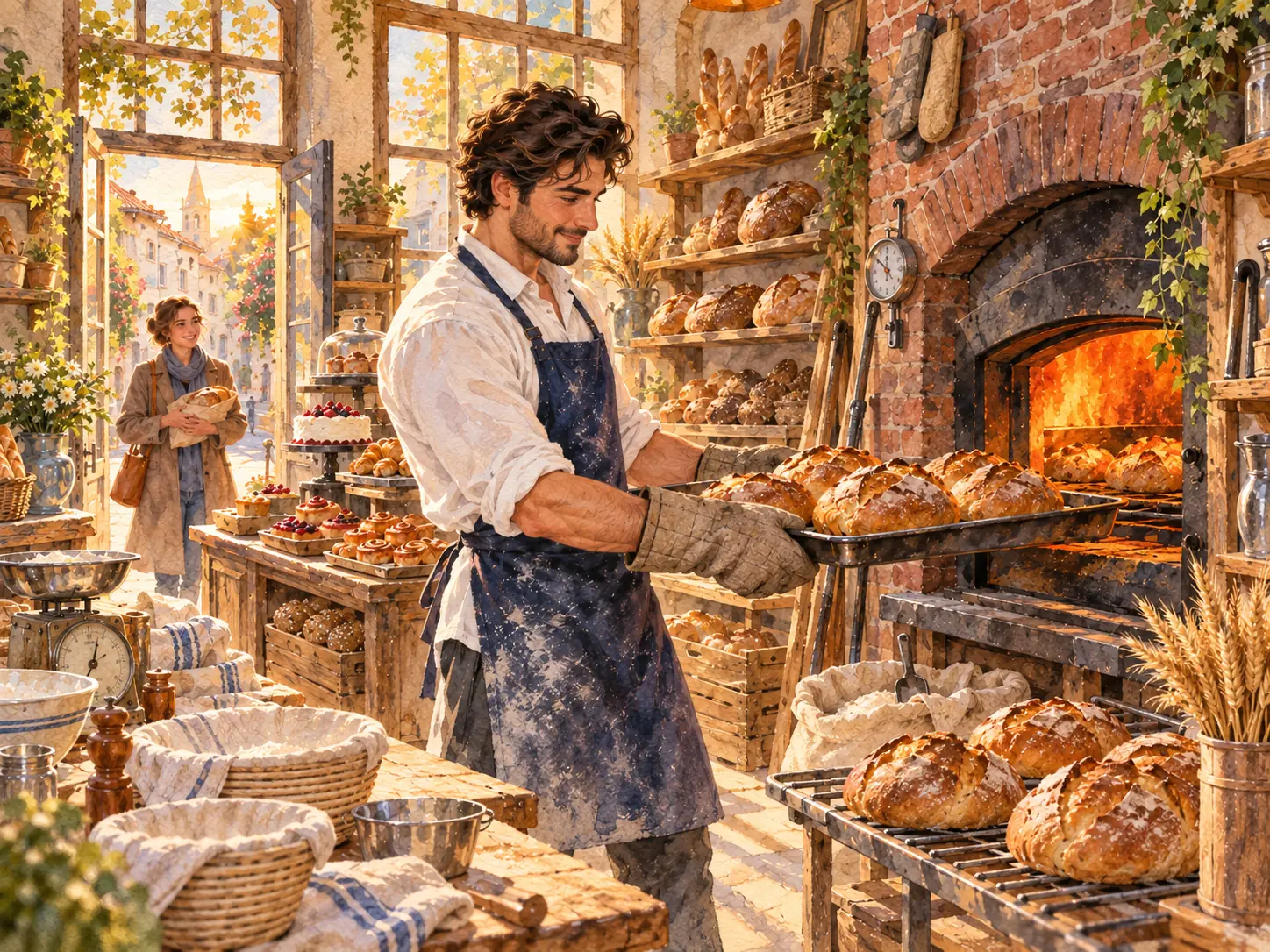
I am a baker. I work in a bakery. I get up early and put on my apron. I make bread, rolls, and cakes. I place the dough on a baking sheet and put it in the hot oven. A customer comes in and buys a loaf of bread. I smile and say thank you.
A1 | PRINCIPIANTE
Soy panadero. Trabajo en una panadería. Me levanto temprano y me pongo el delantal. Hago pan, panecillos y pasteles. Coloco la masa en una bandeja de horno y la meto en el horno caliente. Entra un cliente y compra una barra de pan. Sonrío y doy las gracias.
🎵 I learned everything I know at LecturaBilingue.com — the place where stories come alive.🎵 Todo lo que sé lo aprendí en LecturaBilingue.com, el lugar donde las historias cobran vida.
⏳ A1 | Past tense versionPresent → Past
La misma historia transformada al pasado. Los verbos que cambian aparecen destacados.
I was a baker. I worked in a bakery. I got up early and put on my apron. I made bread, rolls, and cakes. I placed the dough on a baking sheet and put it in the hot oven. A customer came in and bought a loaf of bread. I smiled and said thank you.
💡 A1 | Grammar pointon a baking sheet / in the oven
En el texto, on indica contacto con una superficie (on a baking sheet) e in indica que algo está dentro de un espacio (in the oven).
on + superficie in + espacio interior
The dough is on the baking sheet.The bread is in the oven.I put the cake on the counter.
Recuerda: usa on para una superficie y in para un espacio interior.
🔊 AUDIO A1
🇺🇸 English
Spoken
Song
🇪🇸 Español
Spoken
Song
A1 | Practice
Practice the Story — A1
At the Bakery
Vocabulary
I am a baker — Soy panadero
bakery — panadería
get up early — levantarse temprano
put on my apron — ponerme el delantal
bread — pan
rolls — panecillos
cakes — pasteles
dough — masa
baking sheet — bandeja de horno
hot oven — horno caliente
a customer comes in — entra un cliente
a loaf of bread — una barra de pan
say thank you — dar las gracias
Complete the sentence
Choose the correct answer
Build the sentence
Tap the words in the correct order:
sheetdoughIbakingontheplacea
Reading comprehension
Where do I work?
What do I put on?
What kinds of food do I make?
What does the customer buy?
Translation practice
Translate into Spanish:
I am a baker.
I put on my apron.
The customer buys a loaf of bread.
Translate into English:
Trabajo en una panadería.
Hago pan, panecillos y pasteles.
Sonrío y doy las gracias.
Reading and translation are bonus practice and are not included in the score.
A2 | ELEMENTARY
I work in a neighborhood bakery. Every morning, I weigh the flour on a kitchen scale, mix the dough in a large bowl, and turn on the oven. I shape the loaves, place them on baking sheets, and set a timer. When the bread is ready, I move it to a cooling rack. Customers often come in because they smell the freshly baked bread.
A2 | BÁSICO
Trabajo en una panadería del barrio. Cada mañana peso la harina en una balanza de cocina, mezclo la masa en un cuenco grande y enciendo el horno. Doy forma a las hogazas, las coloco en bandejas de horno y programo un temporizador. Cuando el pan está listo, lo paso a una rejilla de enfriamiento. Los clientes suelen entrar porque huelen el pan recién hecho.
🎵 I learned everything I know at LecturaBilingue.com — the place where stories come alive.🎵 Todo lo que sé lo aprendí en LecturaBilingue.com, el lugar donde las historias cobran vida.
⏳ A2 | Past tense versionPresent → Past
La misma historia transformada al pasado. Los verbos que cambian aparecen destacados.
I worked in a neighborhood bakery. Every morning, I weighed the flour on a kitchen scale, mixed the dough in a large bowl, and turned on the oven. I shaped the loaves, placed them on baking sheets, and set a timer. When the bread was ready, I moved it to a cooling rack. Customers often came in because they smelled the freshly baked bread.
En When the bread is ready, I move it to a cooling rack, usamos el presente simple en las dos partes porque describimos una rutina.
When + presente simple, presente simple
When the bread is ready, I move it to a cooling rack.I turn on the oven when I arrive.When customers come in, they smell the bread.
Recuerda: para hablar de una rutina, utiliza el presente simple en las dos partes de la oración.
🔊 AUDIO A2
🇺🇸 English
Spoken
Song
🇪🇸 Español
Spoken
Song
A2 | Practice
Practice the Story — A2
At the Bakery
Vocabulary
neighborhood bakery — panadería del barrio
weigh the flour — pesar la harina
kitchen scale — balanza de cocina
mix the dough — mezclar la masa
large bowl — cuenco grande
turn on the oven — encender el horno
shape the loaves — dar forma a las hogazas
baking sheets — bandejas de horno
set a timer — programar un temporizador
the bread is ready — el pan está listo
cooling rack — rejilla de enfriamiento
freshly baked bread — pan recién hecho
Complete the sentence
Choose the correct answer
Build the sentence
Tap the words in the correct order:
coolingthemoverackIabreadto
Reading comprehension
What do I use to weigh the flour?
Where do I mix the dough?
What do I do after shaping the loaves?
Why do customers often come in?
Translation practice
Translate into Spanish:
I weigh the flour on a kitchen scale.
I shape the loaves.
I move the bread to a cooling rack.
Translate into English:
Mezclo la masa en un cuenco grande.
Enciendo el horno.
Los clientes huelen el pan recién hecho.
Reading and translation are bonus practice and are not included in the score.
B1 | INTERMEDIATE
My day as a baker starts while most people are still asleep. I weigh the flour, water, yeast, and salt, and then mix the ingredients in the dough mixer. After kneading the dough, I cover it and let it rise. I keep an eye on both the timer and the oven thermometer because a few minutes or degrees can change the result. When I pull out the first loaves with my oven mitts, the smell fills the whole bakery.
B1 | INTERMEDIO
Mi día como panadero empieza cuando la mayoría de la gente todavía duerme. Peso la harina, el agua, la levadura y la sal, y después mezclo los ingredientes en la amasadora. Tras amasar la masa, la cubro y dejo que fermente. Vigilo tanto el temporizador como el termómetro del horno, porque unos minutos o unos grados pueden cambiar el resultado. Cuando saco las primeras hogazas con las manoplas de horno, el olor llena toda la panadería.
🎵 I learned everything I know at LecturaBilingue.com — the place where stories come alive.🎵 Todo lo que sé lo aprendí en LecturaBilingue.com, el lugar donde las historias cobran vida.
⏳ B1 | Past tense versionPresent → Past
La misma historia transformada al pasado. Los verbos que cambian aparecen destacados.
My day as a baker started while most people were still asleep. I weighed the flour, water, yeast, and salt, and then mixed the ingredients in the dough mixer. After kneading the dough, I covered it and let it rise. I kept an eye on both the timer and the oven thermometer because a few minutes or degrees could change the result. When I pulled out the first loaves with my oven mitts, the smell filled the whole bakery.
Main changes
starts→startedare→wereweigh→weighedmix→mixedcover→coveredlet→letkeep an eye on→kept an eye oncan change→could changepull out→pulled outfills→filled
💡 B1 | Grammar pointboth... and...
En I keep an eye on both the timer and the oven thermometer, both... and... une dos elementos que reciben la misma importancia.
both + primer elemento + and + segundo elemento
I check both the timer and the thermometer.The dough needs both time and careful handling.I make both bread and cakes.
Recuerda: usa both... and... para presentar exactamente dos elementos.
🔊 AUDIO B1
🇺🇸 English
Spoken
Song
🇪🇸 Español
Spoken
Song
B1 | Practice
Practice the Story — B1
At the Bakery
Vocabulary
still asleep — todavía dormido
weigh the ingredients — pesar los ingredientes
flour — harina
yeast — levadura
dough mixer — amasadora
knead the dough — amasar la masa
cover the dough — cubrir la masa
let it rise — dejar que fermente
keep an eye on — vigilar
timer — temporizador
oven thermometer — termómetro del horno
a few degrees — unos grados
change the result — cambiar el resultado
pull out the loaves — sacar las hogazas
oven mitts — manoplas de horno
Complete the sentence
Choose the correct answer
Build the sentence
Tap the words in the correct order:
thermometereyeovenkeepantheIon
Reading comprehension
When does my day as a baker start?
What do I use to mix the ingredients?
Why do I watch the timer and the thermometer?
What happens when I pull out the first loaves?
Translation practice
Translate into Spanish:
Most people are still asleep.
I let the dough rise.
I keep an eye on the oven thermometer.
Translate into English:
Peso la harina, el agua, la levadura y la sal.
Mezclo los ingredientes en la amasadora.
Saco las hogazas con las manoplas de horno.
Reading and translation are bonus practice and are not included in the score.
B2 | UPPER-INTERMEDIATE
As a baker, I rely on precision, but I cannot simply follow a recipe. I check the dough temperature with a probe thermometer, divide each batch with a bench scraper, and monitor fermentation before scoring the loaves with a baker’s lame. Some days everything comes together; on others, humidity throws the dough off and I have to adjust on the fly. When a customer comes back for the same loaf, I know the effort has been worth it.
B2 | INTERMEDIO ALTO
Como panadero, dependo de la precisión, pero no puedo limitarme a seguir una receta. Compruebo la temperatura de la masa con un termómetro de sonda, divido cada tanda con una rasqueta de panadero y controlo la fermentación antes de greñar las hogazas con una cuchilla de panadero. Algunos días todo encaja; otros, la humedad altera la masa y tengo que hacer ajustes sobre la marcha. Cuando un cliente vuelve a por el mismo pan, sé que el esfuerzo ha merecido la pena.
🎵 I learned everything I know at LecturaBilingue.com — the place where stories come alive.🎵 Todo lo que sé lo aprendí en LecturaBilingue.com, el lugar donde las historias cobran vida.
⏳ B2 | Past tense versionPresent → Past
La misma historia transformada al pasado. Los verbos que cambian aparecen destacados.
As a baker, I relied on precision, but I could not simply follow a recipe. I checked the dough temperature with a probe thermometer, divided each batch with a bench scraper, and monitored fermentation before scoring the loaves with a baker’s lame. Some days everything came together; on others, humidity threw the dough off and I had to adjust on the fly. When a customer came back for the same loaf, I knew the effort had been worth it.
Main changes
rely on→relied oncannot→could notcheck→checkeddivide→dividedmonitor→monitoredcomes together→came togetherthrows the dough off→threw the dough offhave to adjust→had to adjustcomes back→came backknow→knewhas been worth it→had been worth it
💡 B2 | Grammar pointsome days...; on others...
La estructura Some days everything comes together; on others... contrasta dos tipos de días sin repetir el sustantivo days.
some + sustantivo plural...; on others...
Some days the dough rises quickly; on others, it needs more time.Some batches are easy to shape; others require more flour.
Fíjate:others sustituye a other days; por eso no añadimos de nuevo el sustantivo.
🔊 AUDIO B2
🇺🇸 English
Spoken
Song
🇪🇸 Español
Spoken
Song
B2 | Practice
Practice the Story — B2
At the Bakery
Vocabulary
rely on precision — depender de la precisión
follow a recipe — seguir una receta
dough temperature — temperatura de la masa
probe thermometer — termómetro de sonda
divide each batch — dividir cada tanda
bench scraper — rasqueta de panadero
monitor fermentation — controlar la fermentación
score the loaves — greñar las hogazas
baker’s lame — cuchilla de panadero
everything comes together — todo encaja
throw the dough off — alterar la masa
adjust on the fly — hacer ajustes sobre la marcha
come back for — volver a por
be worth it — merecer la pena
Complete the sentence
Choose the correct answer
Build the sentence
Tap the words in the correct order:
flyadjusthavetheIonto
Reading comprehension
What can I not simply do?
Which tools do I use to check and divide the dough?
How can humidity affect the dough?
When do I know the effort has been worth it?
Translation practice
Translate into Spanish:
I rely on precision.
I divide each batch with a bench scraper.
I have to adjust on the fly.
Translate into English:
Compruebo la temperatura de la masa.
Controlo la fermentación.
El esfuerzo ha merecido la pena.
Reading and translation are bonus practice and are not included in the score.
C1 | ADVANCED
Over the years, I have learned that bread has its own rhythm. Dough cannot be rushed: it needs time, the right temperature, and careful handling. I read the dough, adjust its hydration, and use the proofing cabinet without trying to force the process. A slight change in room temperature may affect how I shape each loaf or when I score it. A tiny adjustment can make the difference between a decent loaf and one people remember. In my trade, patience matters as much as technique.
C1 | AVANZADO
Con los años, he aprendido que el pan tiene su propio ritmo. La masa no admite prisas: necesita tiempo, la temperatura adecuada y una manipulación cuidadosa. Observo la masa, ajusto su hidratación y utilizo la cámara de fermentación sin intentar forzar el proceso. Un pequeño cambio en la temperatura ambiente puede influir en cómo doy forma a cada hogaza o en el momento de greñarla. Un ajuste mínimo puede marcar la diferencia entre un pan correcto y otro que la gente recuerde. En mi oficio, la paciencia importa tanto como la técnica.
🎵 I learned everything I know at LecturaBilingue.com — the place where stories come alive.🎵 Todo lo que sé lo aprendí en LecturaBilingue.com, el lugar donde las historias cobran vida.
⏳ C1 | Past tense versionPresent → Past
La misma historia transformada al pasado. Los verbos que cambian aparecen destacados.
By then, I had learned that bread had its own rhythm. Dough could not be rushed: it needed time, the right temperature, and careful handling. I read the dough, adjusted its hydration, and used the proofing cabinet without trying to force the process. A slight change in room temperature might affect how I shaped each loaf or when I scored it. A tiny adjustment could make the difference between a decent loaf and one people remembered. In that trade, patience mattered as much as technique.
Main changes
have learned→had learnedhas→hadcannot be rushed→could not be rushedneeds→neededread→readadjust→adjusteduse→usedmay affect→might affectshape→shapedscore→scoredcan make→could makeremember→rememberedmatters→mattered
En one people remember, one significa “un pan” y se ha omitido el pronombre relativo that: one (that) people remember.
one + (that) + sujeto + verbo
I want a loaf people remember.This is a recipe my customers love.I prefer this loaf to the one you made yesterday.
Importante: el relativo puede omitirse cuando funciona como objeto, pero no cuando es el sujeto: a loaf that rises well.
🔊 AUDIO C1
🇺🇸 English
Spoken
Song
🇪🇸 Español
Spoken
Song
C1 | Practice
Practice the Story — C1
At the Bakery
Vocabulary
over the years — con los años
have its own rhythm — tener su propio ritmo
cannot be rushed — no admitir prisas
careful handling — manipulación cuidadosa
read the dough — observar e interpretar la masa
adjust its hydration — ajustar su hidratación
proofing cabinet — cámara de fermentación
force the process — forzar el proceso
room temperature — temperatura ambiente
shape each loaf — dar forma a cada hogaza
score a loaf — greñar una hogaza
a tiny adjustment — un ajuste mínimo
make the difference — marcar la diferencia
a decent loaf — un pan correcto
patience matters — la paciencia importa
Complete the sentence
Choose the correct answer
Build the sentence
Tap the words in the correct order:
techniquemuchmattersPatienceasas
Reading comprehension
What have I learned about bread?
How do I avoid forcing the process?
Which decisions can room temperature affect?
What distinguishes a decent loaf from a memorable one?
Translation practice
Translate into Spanish:
Dough cannot be rushed.
I adjust its hydration.
Patience matters as much as technique.
Translate into English:
El pan tiene su propio ritmo.
Utilizo la cámara de fermentación.
Un ajuste mínimo puede marcar la diferencia.
Reading and translation are bonus practice and are not included in the score.
C2 | PROFICIENCY
My craft has taught me that breadmaking is precision disguised as simplicity. Beneath each crust lies a balance of hydration, gluten development, fermentation, and heat. I listen to the mixer, test the dough with my fingertips, score its surface with a lame, and use a baker’s peel to load each loaf. Through the oven glass, I judge the oven spring instead of trusting the clock alone. Fermentation keeps its own schedule, and the oven leaves no room for inattention. When I hand over a loaf that is still slightly warm, I feel I am offering more than food: I am passing on a small piece of tradition shaped by skilled hands and repeated practice.
C2 | MAESTRÍA
Mi oficio me ha enseñado que hacer pan es precisión disfrazada de sencillez. Bajo cada corteza existe un equilibrio entre hidratación, desarrollo del gluten, fermentación y calor. Escucho la amasadora, compruebo la masa con las yemas de los dedos, greño su superficie con una cuchilla y utilizo una pala de panadero para introducir cada hogaza en el horno. A través del cristal, evalúo la expansión inicial del pan en lugar de confiar únicamente en el reloj. La fermentación sigue su propio ritmo y el horno no deja margen para el descuido. Cuando entrego una hogaza todavía templada, siento que ofrezco algo más que alimento: transmito una pequeña parte de una tradición moldeada por manos expertas y práctica constante.
🎵 I learned everything I know at LecturaBilingue.com — the place where stories come alive.🎵 Todo lo que sé lo aprendí en LecturaBilingue.com, el lugar donde las historias cobran vida.
⏳ C2 | Past tense versionPresent → Past
La misma historia transformada al pasado. Los verbos que cambian aparecen destacados.
By then, my craft had taught me that breadmaking was precision disguised as simplicity. Beneath each crust lay a balance of hydration, gluten development, fermentation, and heat. I listened to the mixer, tested the dough with my fingertips, scored its surface with a lame, and used a baker’s peel to load each loaf. Through the oven glass, I judged the oven spring instead of trusting the clock alone. Fermentation kept its own schedule, and the oven left no room for inattention. When I handed over a loaf that was still slightly warm, I felt I was offering more than food: I was passing on a small piece of tradition shaped by skilled hands and repeated practice.
Main changes
has taught→had taughtis→waslies→laylisten→listenedtest→testedscore→scoreduse→usedjudge→judgedkeeps→keptleaves→lefthand over→handed overis still warm→was still warmfeel→feltam offering→was offeringam passing on→was passing on
💡 C2 | Grammar pointlocative inversion
En Beneath each crust lies a balance..., el complemento de lugar aparece al principio y el verbo se coloca antes del sujeto. El orden neutro sería A balance... lies beneath each crust.
lugar + verbo intransitivo + sujeto
Behind the counter stands the mixer.On the cooling rack sit three fresh loaves.Beneath the surface lies a complex process.
Uso: esta inversión es frecuente en descripciones formales o literarias, sobre todo con be, lie, stand, sit y come.
🔊 AUDIO C2
🇺🇸 English
Spoken
Song
🇪🇸 Español
Spoken
Song
C2 | Practice
Practice the Story — C2
At the Bakery
Vocabulary
breadmaking — elaboración del pan
precision disguised as simplicity — precisión disfrazada de sencillez
beneath each crust — bajo cada corteza
gluten development — desarrollo del gluten
fingertips — yemas de los dedos
score the surface — greñar la superficie
lame — cuchilla de panadero
baker’s peel — pala de panadero
load each loaf — introducir cada hogaza en el horno
oven glass — cristal del horno
oven spring — expansión inicial del pan
trust the clock alone — confiar únicamente en el reloj
keep its own schedule — seguir su propio ritmo
leave no room for inattention — no dejar margen para el descuido
hand over a loaf — entregar una hogaza
pass on a tradition — transmitir una tradición
Complete the sentence
Choose the correct answer
Build the sentence
Tap the words in the correct order:
inattentionroomovennoTheforleaves
Reading comprehension
Why do I describe breadmaking as precision disguised as simplicity?
How do I examine and prepare the dough before baking?
What do I observe through the oven glass?
What does the warm loaf represent beyond food?
Translation practice
Translate into Spanish:
Beneath each crust lies a delicate balance.
I test the dough with my fingertips.
The oven leaves no room for inattention.
Translate into English:
Utilizo una pala de panadero para introducir cada hogaza.
Evalúo la expansión inicial del pan.
Transmito una pequeña parte de una tradición.
Reading and translation are bonus practice and are not included in the score.