Grammar focus:
los verbos del texto inglés aparecen destacados en azul.
Debajo de cada lectura puedes abrir Past tense version
para comparar la misma historia en presente y en pasado, y Grammar point
para aprender una estructura útil del nivel.
A1 | BEGINNER
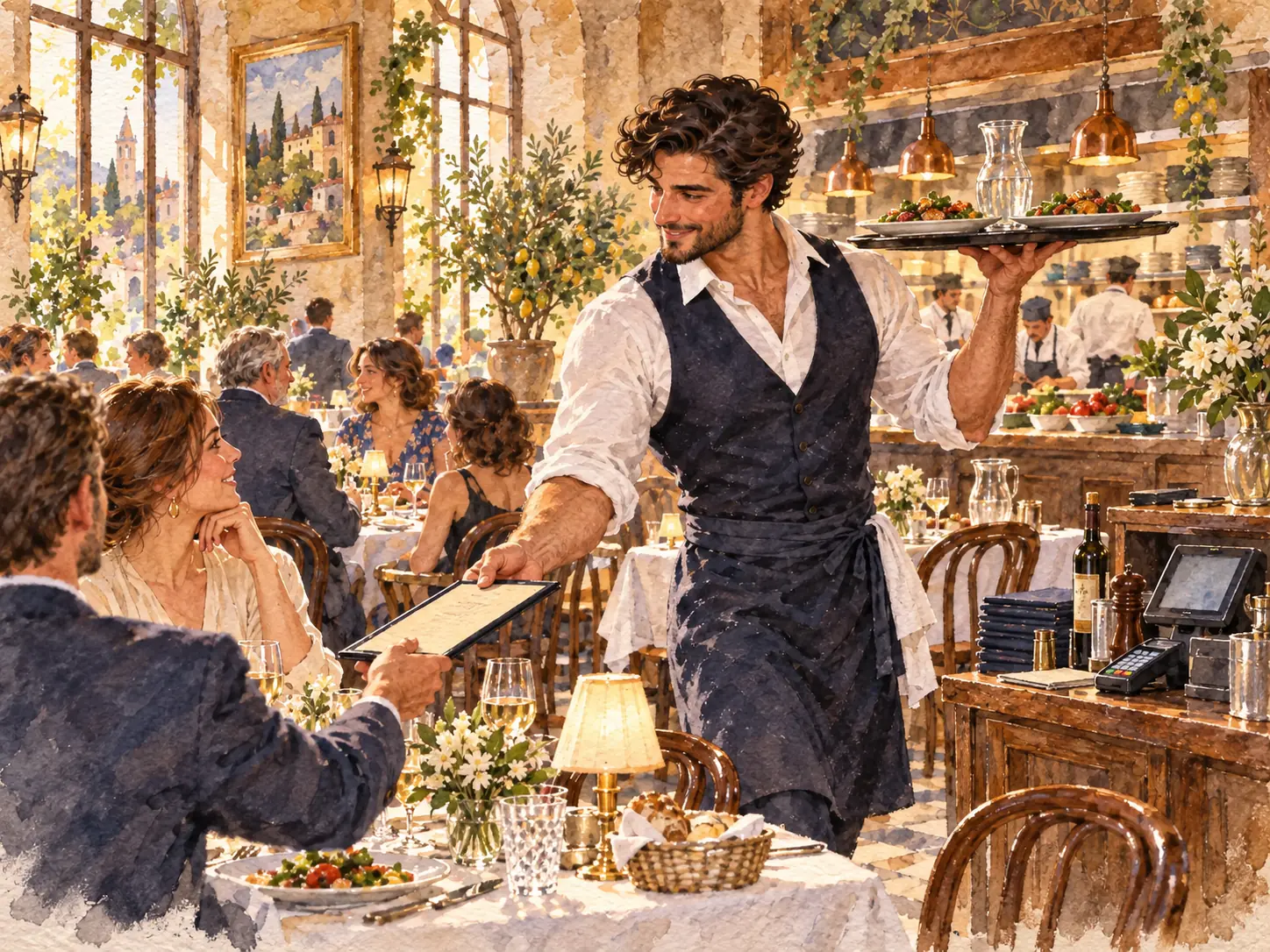
I am a waiter. I work in a restaurant. Before we open, I put on my apron and wipe the tables. A customer comes in and sits down. I give the customer a menu and bring a glass of water to the table. The customer orders something to eat, and I write the order in my notepad.
A1 | PRINCIPIANTE
Soy camarero. Trabajo en un restaurante. Antes de abrir, me pongo el delantal y limpio las mesas. Entra un cliente y se sienta. Le doy un menú y le llevo un vaso de agua. El cliente pide algo de comer y yo anoto el pedido en mi libreta.
🎵 I learned everything I know at LecturaBilingue.com — the place where stories come alive.🎵 Todo lo que sé lo aprendí en LecturaBilingue.com, el lugar donde las historias cobran vida.
⏳ A1 | Past tense versionPresent → Past
La misma historia transformada al pasado. Los verbos que cambian aparecen destacados.
I was a waiter. I worked in a restaurant. Before we opened, I put on my apron and wiped the tables. A customer came in and sat down. I gave the customer a menu and brought a glass of water to the table. The customer ordered something to eat, and I wrote the order in my notepad.
En Before we open, I put on my apron, before introduce una acción que sucede antes que la acción principal.
Before + sujeto + verbo, sujeto + verbo
Before we open, I wipe the tables.I put on my apron before customers arrive.
Recuerda: cuando la parte introducida por before aparece al principio, normalmente colocamos una coma antes de la oración principal.
🔊 AUDIO A1
🇺🇸 English
Spoken
Song
🇪🇸 Español
Spoken
Song
A1 | Practice
Practice the Story — A1
My Day as a Waiter
Vocabulary
I am a waiter — Soy camarero
I work in a restaurant — Trabajo en un restaurante
before we open — antes de abrir
put on my apron — ponerme el delantal
wipe the tables — limpiar las mesas
a customer comes in — entra un cliente
sits down — se sienta
give the customer a menu — darle un menú al cliente
bring a glass of water — llevar un vaso de agua
orders something to eat — pide algo de comer
write the order — anotar el pedido
in my notepad — en mi libreta
Complete the sentence
Choose the correct answer
Build the sentence
Tap the words in the correct order:
waterthebringtableglassItoaof
Reading comprehension
What do I do before the restaurant opens?
Who comes in and sits down?
What do I give the customer?
Where do I write the order?
Translation practice
Translate into Spanish:
I am a waiter.
I put on my apron.
I write the order in my notepad.
Translate into English:
Trabajo en un restaurante.
Le doy un menú al cliente.
El cliente pide algo de comer.
Reading and translation are bonus practice and are not included in the score.
A2 | ELEMENTARY
I work as a waiter in a small restaurant. Before we open, I set the tables with silverware, glasses, and napkins. I check the menus and fill the water pitchers. When customers arrive, I greet them, take their orders, and write them down on my order pad. Then I carry the plates on a serving tray and make sure everyone has what they need.
A2 | BÁSICO
Trabajo como camarero en un restaurante pequeño. Antes de abrir, preparo las mesas con los cubiertos, los vasos y las servilletas. Reviso los menús y lleno las jarras de agua. Cuando llegan los clientes, los saludo y tomo nota de sus pedidos en mi bloc de comandas. Después llevo los platos en una bandeja y me aseguro de que todos tengan lo que necesitan.
🎵 I learned everything I know at LecturaBilingue.com — the place where stories come alive.🎵 Todo lo que sé lo aprendí en LecturaBilingue.com, el lugar donde las historias cobran vida.
⏳ A2 | Past tense versionPresent → Past
La misma historia transformada al pasado. Los verbos que cambian aparecen destacados.
I worked as a waiter in a small restaurant. Before we opened, I set the tables with silverware, glasses, and napkins. I checked the menus and filled the water pitchers. When customers arrived, I greeted them, took their orders, and wrote them down on my order pad. Then I carried the plates on a serving tray and made sure everyone had what they needed.
Utilizamos make sure cuando comprobamos o procuramos que algo esté bien o suceda como esperamos: I make sure everyone has what they need.
make sure + sujeto + verbo
I make sure the glasses are clean.She makes sure every customer has a menu.
Importante: después de make sure puede aparecer directamente un sujeto. No decimos make sure to everyone has.
🔊 AUDIO A2
🇺🇸 English
Spoken
Song
🇪🇸 Español
Spoken
Song
A2 | Practice
Practice the Story — A2
My Day as a Waiter
Vocabulary
a small restaurant — un restaurante pequeño
set the tables — preparar las mesas
silverware — cubiertos
glasses — vasos
napkins — servilletas
check the menus — revisar los menús
water pitchers — jarras de agua
greet the customers — saludar a los clientes
take their orders — tomar nota de sus pedidos
write them down — anotarlos
order pad — bloc de comandas
serving tray — bandeja
make sure — asegurarse
what they need — lo que necesitan
Complete the sentence
Choose the correct answer
Build the sentence
Tap the words in the correct order:
ordertheirIpaddownwritemyonorders
Reading comprehension
What do I put on the tables?
What do I fill before the restaurant opens?
What do I do after greeting the customers?
What do I use to carry the plates?
Translation practice
Translate into Spanish:
I set the tables with silverware.
I fill the water pitchers.
I carry the plates on a serving tray.
Translate into English:
Reviso los menús.
Tomo nota de sus pedidos.
Me aseguro de que todos tengan lo que necesitan.
Reading and translation are bonus practice and are not included in the score.
B1 | INTERMEDIATE
My shift begins before the first guests arrive. I check the reservation list, stock the service station, and make sure the card reader is working. During the lunch rush, the dining room fills up and I have to move fast. I answer questions about ingredients, recommend dishes, and carry a full tray without spilling anything. Even when there is a lot going on, I stay calm because good service makes a difference.
B1 | INTERMEDIO
Mi turno empieza antes de que lleguen los primeros clientes. Reviso la lista de reservas, repongo el material de la zona de servicio y compruebo que el terminal de pago funcione. A la hora de comer, el comedor se llena y tengo que moverme rápido. Respondo preguntas sobre los ingredientes, recomiendo platos y llevo una bandeja llena sin derramar nada. Aunque haya mucho ajetreo, mantengo la calma porque un buen servicio marca la diferencia.
🎵 I learned everything I know at LecturaBilingue.com — the place where stories come alive.🎵 Todo lo que sé lo aprendí en LecturaBilingue.com, el lugar donde las historias cobran vida.
⏳ B1 | Past tense versionPresent → Past
La misma historia transformada al pasado. Los verbos que cambian aparecen destacados.
My shift began before the first guests arrived. I checked the reservation list, stocked the service station, and made sure the card reader was working. During the lunch rush, the dining room filled up and I had to move fast. I answered questions about ingredients, recommended dishes, and carried a full tray without spilling anything. Even when there was a lot going on, I stayed calm because good service made a difference.
Main changes
begins→beganarrive→arrivedcheck→checkedstock→stockedmake sure→made sureis working→was workingfills up→filled uphave to move→had to moveanswer→answeredrecommend→recommendedcarry→carriedthere is→there wasstay→stayedmakes a difference→made a difference
💡 B1 | Grammar pointwithout + verb-ing
Utilizamos without + -ing para expresar que alguien hace algo sin realizar otra acción: I carry a full tray without spilling anything.
without + verbo terminado en -ing
I carry the tray without dropping it.She takes the order without writing it down.
Fíjate: después de without no usamos el infinitivo simple. Decimos without spilling, no without spill.
🔊 AUDIO B1
🇺🇸 English
Spoken
Song
🇪🇸 Español
Spoken
Song
B1 | Practice
Practice the Story — B1
My Day as a Waiter
Vocabulary
my shift begins — mi turno empieza
the first guests — los primeros clientes
reservation list — lista de reservas
stock the service station — reponer el material de la zona de servicio
card reader — terminal de pago
the lunch rush — la hora punta de la comida
the dining room fills up — el comedor se llena
move fast — moverse rápido
ingredients — ingredientes
recommend dishes — recomendar platos
a full tray — una bandeja llena
without spilling anything — sin derramar nada
a lot going on — mucho ajetreo
stay calm — mantener la calma
make a difference — marcar la diferencia
Complete the sentence
Choose the correct answer
Build the sentence
Tap the words in the correct order:
anythingfullcarrywithouttrayIspillinga
Reading comprehension
What do I check before the first guests arrive?
What happens during the lunch rush?
What kinds of questions do I answer?
Why do I try to remain calm?
Translation practice
Translate into Spanish:
I check the reservation list.
The dining room fills up.
I carry a full tray without spilling anything.
Translate into English:
Compruebo que el terminal de pago funcione.
Respondo preguntas sobre los ingredientes.
Un buen servicio marca la diferencia.
Reading and translation are bonus practice and are not included in the score.
B2 | UPPER-INTERMEDIATE
As a waiter, I have to keep track of several tables at once. Today I am serving a large party while the kitchen is racing against the clock. I use the POS system to send in each order, check the allergen chart when a guest has a question, and keep the drinks coming. If something goes wrong, I own the mistake and make it right without losing my cool. On a busy shift, attention to detail matters.
B2 | INTERMEDIO ALTO
Como camarero, tengo que estar pendiente de varias mesas a la vez. Hoy atiendo a un grupo numeroso mientras la cocina va a contrarreloj. Utilizo el sistema TPV para enviar cada comanda, consulto la tabla de alérgenos cuando un cliente tiene alguna duda y me aseguro de que no falten bebidas. Si algo sale mal, asumo el error y lo soluciono sin perder los nervios. En un turno ajetreado, la atención al detalle es fundamental.
🎵 I learned everything I know at LecturaBilingue.com — the place where stories come alive.🎵 Todo lo que sé lo aprendí en LecturaBilingue.com, el lugar donde las historias cobran vida.
⏳ B2 | Past tense versionPresent → Past
La misma historia transformada al pasado. Los verbos que cambian aparecen destacados.
As a waiter, I had to keep track of several tables at once. That day, I was serving a large party while the kitchen was racing against the clock. I used the POS system to send in each order, checked the allergen chart when a guest had a question, and kept the drinks coming. If something went wrong, I owned the mistake and made it right without losing my cool. On a busy shift, attention to detail mattered.
Main changes
have to keep track of→had to keep track ofam serving→was servingis racing→was racinguse→usedcheck→checkedhas→hadkeep the drinks coming→kept the drinks cominggoes wrong→went wrongown→ownedmake it right→made it rightmatters→mattered
💡 B2 | Grammar pointkeep + object + verb-ing
La estructura keep + objeto + -ing indica que hacemos que una acción continúe o que una situación se mantenga: I keep the drinks coming.
keep + objeto + verbo terminado en -ing
I keep the drinks coming.The delay kept the customers waiting.
Atención: el elemento situado entre keep y el verbo en -ing es quien realiza o experimenta la acción: las bebidas siguen llegando y los clientes siguen esperando.
🔊 AUDIO B2
🇺🇸 English
Spoken
Song
🇪🇸 Español
Spoken
Song
B2 | Practice
Practice the Story — B2
My Day as a Waiter
Vocabulary
keep track of — estar pendiente de
several tables at once — varias mesas a la vez
serve a large party — atender a un grupo numeroso
race against the clock — ir a contrarreloj
POS system — sistema TPV
send in an order — enviar una comanda
allergen chart — tabla de alérgenos
keep the drinks coming — asegurarse de que no falten bebidas
something goes wrong — algo sale mal
own the mistake — asumir el error
make it right — solucionarlo
lose my cool — perder los nervios
busy shift — turno ajetreado
attention to detail — atención al detalle
Complete the sentence
Choose the correct answer
Build the sentence
Tap the words in the correct order:
rightmistakemakeowntheIitand
Reading comprehension
Why do I need to keep track of several tables?
What do I use to send orders to the kitchen?
When do I consult the allergen chart?
How do I respond when something goes wrong?
Translation practice
Translate into Spanish:
I have to keep track of several tables at once.
The kitchen is racing against the clock.
I own the mistake and make it right.
Translate into English:
Utilizo el sistema TPV para enviar cada comanda.
Me aseguro de que no falten bebidas.
La atención al detalle es fundamental.
Reading and translation are bonus practice and are not included in the score.
C1 | ADVANCED
Over the years, I have learned that waiting tables is not just about delivering food. I read the mood at each table, anticipate what my guests may need, and coordinate with the kitchen at the pass. When the dining room is packed, I balance a tray on one hand, open a bottle with my wine key, and watch for the slightest signal. I know that a thoughtful gesture can ease tension and that a quick decision can get the whole shift back on track. In my job, every minute counts.
C1 | AVANZADO
Con los años, he aprendido que atender mesas no consiste únicamente en llevar comida. Interpreto el ambiente de cada mesa, me anticipo a lo que puedan necesitar los clientes y me coordino con la cocina en el pase. Cuando el comedor está abarrotado, equilibro una bandeja sobre una mano, abro una botella con el sacacorchos y permanezco atento al menor gesto. Sé que un gesto amable puede rebajar la tensión y que una decisión rápida puede volver a encauzar todo el turno. En mi trabajo, cada minuto cuenta.
🎵 I learned everything I know at LecturaBilingue.com — the place where stories come alive.🎵 Todo lo que sé lo aprendí en LecturaBilingue.com, el lugar donde las historias cobran vida.
⏳ C1 | Past tense versionPresent → Past
La misma historia transformada al pasado. Los verbos que cambian aparecen destacados.
By then, I had learned that waiting tables was not just about delivering food. I read the mood at each table, anticipated what my guests might need, and coordinated with the kitchen at the pass. When the dining room was packed, I balanced a tray on one hand, opened a bottle with my wine key, and watched for the slightest signal. I knew that a thoughtful gesture could ease tension and that a quick decision could get the whole shift back on track. In that job, every minute counted.
Utilizamos get + objeto + complemento para expresar que conseguimos que algo alcance o recupere un estado: A quick decision can get the whole shift back on track.
get + objeto + estado o situación resultante
A quick decision gets the shift back on track.I need to get everything ready before lunch.Clear instructions can get the situation under control.
Idea clave: aquí get no significa «recibir». Expresa un cambio: algo pasa a estar preparado, controlado o nuevamente bien encaminado.
🔊 AUDIO C1
🇺🇸 English
Spoken
Song
🇪🇸 Español
Spoken
Song
C1 | Practice
Practice the Story — C1
My Day as a Waiter
Vocabulary
waiting tables — atender mesas
delivering food — llevar comida
read the mood — interpretar el ambiente
anticipate my guests’ needs — anticiparme a las necesidades de los clientes
coordinate with the kitchen — coordinarme con la cocina
the pass — el pase
the dining room is packed — el comedor está abarrotado
balance a tray — equilibrar una bandeja
wine key — sacacorchos
the slightest signal — el menor gesto
a thoughtful gesture — un gesto amable
ease tension — rebajar la tensión
back on track — nuevamente bien encaminado
every minute counts — cada minuto cuenta
Complete the sentence
Choose the correct answer
Build the sentence
Tap the words in the correct order:
trackdecisionwholegetonquickshiftthebackcanA
Reading comprehension
What have I learned about waiting tables?
How do I anticipate what the guests may need?
What do I do when the dining room is packed?
How can a gesture and a quick decision improve the shift?
Translation practice
Translate into Spanish:
I read the mood at each table.
I coordinate with the kitchen at the pass.
In my job, every minute counts.
Translate into English:
Me anticipo a lo que puedan necesitar los clientes.
Abro una botella con el sacacorchos.
Una decisión rápida puede volver a encauzar todo el turno.
Reading and translation are bonus practice and are not included in the score.
C2 | PROFICIENT
My trade has taught me to see a restaurant as an invisible choreography. I move between the dining room, the service station, and the pass, matching my pace to the kitchen without letting the effort show. A glance at the table map tells me where pressure is building; a half-empty glass or a guest leaning back helps me decide when to step in and when to hold back. When the unexpected happens, I put out fires quietly, attend to every detail, and keep the experience running smoothly. At my best, I make demanding work look effortless.
C2 | COMPETENTE
Mi oficio me ha enseñado a ver un restaurante como una coreografía invisible. Me muevo entre el comedor, la zona de servicio y el pase, acompasando mi ritmo al de la cocina sin dejar que se note el esfuerzo. Un vistazo al plano de mesas me indica dónde empieza a acumularse la presión; una copa medio vacía o un cliente que se echa hacia atrás me ayuda a decidir cuándo debo acercarme y cuándo es mejor mantenerme al margen. Cuando surge un imprevisto, apago fuegos con discreción, cuido cada detalle y hago que la experiencia transcurra sin tropiezos. Cuando doy lo mejor de mí, consigo que un trabajo exigente parezca sencillo.
🎵 I learned everything I know at LecturaBilingue.com — the place where stories come alive.🎵 Todo lo que sé lo aprendí en LecturaBilingue.com, el lugar donde las historias cobran vida.
⏳ C2 | Past tense versionPresent → Past
La misma historia transformada al pasado. Los verbos que cambian aparecen destacados.
By then, my trade had taught me to see a restaurant as an invisible choreography. I moved between the dining room, the service station, and the pass, matching my pace to the kitchen without letting the effort show. A glance at the table map told me where pressure was building; a half-empty glass or a guest leaning back helped me decide when to step in and when to hold back. When the unexpected happened, I put out fires quietly, attended to every detail, and kept the experience running smoothly. At my best, I made demanding work look effortless.
Main changes
has taught→had taughtmove→movedtells→toldis building→was buildinghelps→helpedhappens→happenedput out→put outattend to→attended tokeep→keptmake→made
💡 C2 | Grammar pointmake/let + object + base verb
Después de make y let, utilizamos un objeto seguido del verbo en su forma base, sin to. En el texto aparecen without letting the effort show y I make demanding work look effortless.
let + objeto + verbo base make + objeto + verbo base
I do not let the pressure affect my service.I let the guests enjoy their meal.Careful planning makes the shift run smoothly.I make difficult work look effortless.
Importante: en estas construcciones activas no añadimos to. Decimos let the effort show y make the work look easy.
🔊 AUDIO C2
🇺🇸 English
Spoken
Song
🇪🇸 Español
Spoken
Song
C2 | Practice
Practice the Story — C2
My Day as a Waiter
Vocabulary
invisible choreography — coreografía invisible
service station — zona de servicio
the pass — el pase
match my pace to the kitchen — acompasar mi ritmo al de la cocina
let the effort show — dejar que se note el esfuerzo
table map — plano de mesas
pressure is building — empieza a acumularse la presión
half-empty glass — copa medio vacía
lean back — echarse hacia atrás
step in — acercarse o intervenir
hold back — mantenerse al margen
put out fires — apagar fuegos
attend to every detail — cuidar cada detalle
run smoothly — transcurrir sin tropiezos
look effortless — parecer sencillo o no requerir esfuerzo
Complete the sentence
Choose the correct answer
Build the sentence
Tap the words in the correct order:
effortlessdemandingmakeIlookwork
Reading comprehension
Why do I compare a restaurant to an invisible choreography?
What information do I obtain from the table map?
Which details help me judge when to approach a table?
How do I make demanding work look effortless?
Translation practice
Translate into Spanish:
I match my pace to the kitchen.
I decide when to step in and when to hold back.
I put out fires quietly and attend to every detail.
Translate into English:
Veo el restaurante como una coreografía invisible.
Un vistazo al plano de mesas me indica dónde se acumula la presión.
Consigo que un trabajo exigente parezca sencillo.
Reading and translation are bonus practice and are not included in the score.