
First-person focus: desde la Story 31, el narrador cuenta su trabajo principalmente en primera persona, con abundantes verbos conjugados con I.
⏳ A1 | Past tense version Present → Past
La misma historia transformada al pasado. Los verbos que cambian aparecen destacados.
🧩 A1 | Grammar point see + person + verb
En inglés, después de see podemos poner una persona y después un verbo sin to.
A1 | Practice
Match – Quizlet
Play this part of the story on Quizlet.
Fixing a Pipe
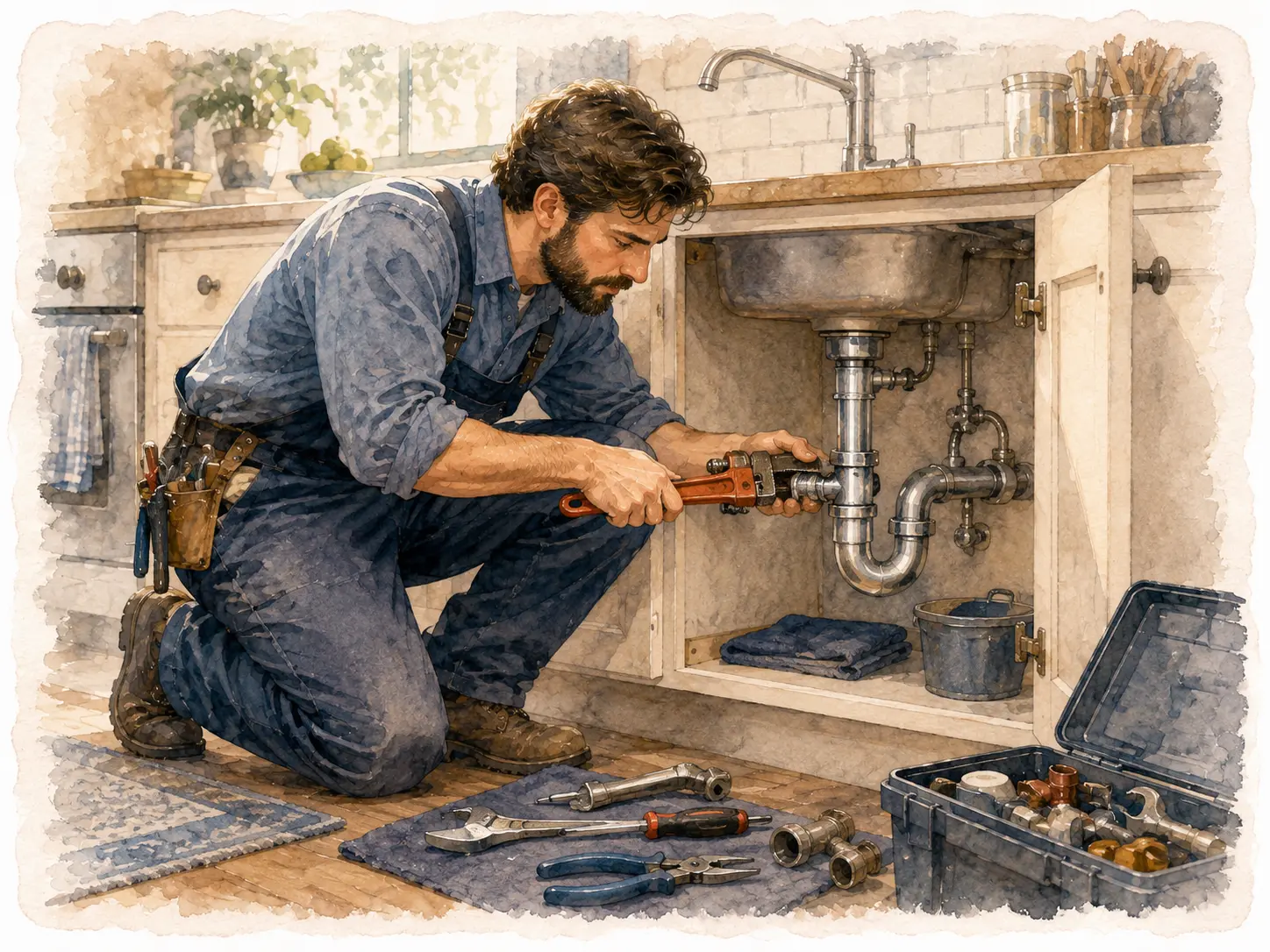
- I am a plumber — soy fontanero
- I go to a house — voy a una casa
- I see water on the floor — veo agua en el suelo
- I look at the pipe — miro la tubería
- I use a wrench — uso una llave inglesa
- I tighten one part — aprieto una pieza
- I fix the leak — reparo la fuga
- I see the person smile — veo sonreír a la persona
Tap the words in the correct order:
- What is the narrator’s job?
- Where is the water?
- What does he use?
- Why does the person smile?
Translate into Spanish:
- I am a plumber.
- I see water on the floor.
- I use a wrench.
- I fix the leak.
Translate into English:
- Soy fontanero.
- Veo agua en el suelo.
- Uso una llave inglesa.
- Reparo la fuga.
Reading and translation are bonus practice and are not included in the score.
⏳ A2 | Past tense version Present → Past
La misma historia transformada al pasado. Los verbos que cambian aparecen destacados.
🧩 A2 | Grammar point make sure + sentence
Make sure significa «asegurarse de que» o «comprobar que» algo está bien.
A2 | Practice
Match – Quizlet
Play this part of the story on Quizlet.
Fixing a Pipe
- I work as a plumber — trabajo como fontanero
- this morning — esta mañana
- fix a leak — reparo una fuga
- under the sink — debajo del fregadero
- turn off the water — cierro el agua
- check the pipe — reviso la tubería
- replace a small part — cambio una pieza pequeña
- clean the area — limpio la zona
- make sure — me aseguro
- everything works properly — todo funciona bien
- I solve the problem — soluciono el problema
Tap the words in the correct order:
- What does the narrator do for work?
- Where is the leak?
- What does he do first?
- What does he check at the end?
Translate into Spanish:
- I work as a plumber.
- This morning, I fix a leak under the sink.
- First, I turn off the water.
- I solve the problem.
Translate into English:
- Trabajo como fontanero.
- Reparo una fuga debajo del fregadero.
- Cambio una pieza pequeña.
- Soluciono el problema.
Reading and translation are bonus practice and are not included in the score.
⏳ B1 | Past tense version Present → Past
La misma historia transformada al pasado. Los verbos que cambian aparecen destacados.
🧩 B1 | Grammar point turn something back on
Turn on es «encender» o «abrir» un suministro. Si añadimos back, expresamos que lo volvemos a poner como estaba.
B1 | Practice
Match – Quizlet
Play this part of the story on Quizlet.
Fixing a Pipe
- as a plumber — como fontanero
- I need patience — necesito paciencia
- attention to detail — atención al detalle
- a customer calls me — un cliente me llama
- a leak in the kitchen — una fuga en la cocina
- when I arrive — cuando llego
- check the sink — reviso el fregadero
- the seals — las juntas
- the main pipe — la tubería principal
- a worn part — una pieza desgastada
- replace it — la sustituyo
- I turn the water back on — vuelvo a abrir el agua
- little by little — poco a poco
- I see that the customer feels relieved — veo que el cliente se siente aliviado
Tap the words in the correct order:
- What does the narrator need as a plumber?
- Why does the customer call him?
- What parts does he check when he arrives?
- What does he replace?
- Why does the customer feel relieved?
Translate into Spanish:
- As a plumber, I need patience and attention to detail.
- Today a customer calls me because there is a leak in the kitchen.
- I find a worn part and replace it.
- I see that the customer feels relieved.
Translate into English:
- Como fontanero, necesito paciencia y atención al detalle.
- Un cliente me llama porque tiene una fuga en la cocina.
- Después vuelvo a abrir el agua poco a poco.
- Veo que el cliente se siente aliviado.
Reading and translation are bonus practice and are not included in the score.
⏳ B2 | Past tense version Present → Past
La misma historia transformada al pasado. Los verbos que cambian aparecen destacados.
🧩 B2 | Grammar point prevent ... from + -ing
Para decir «evitar que algo ocurra», una estructura muy útil es prevent + objeto + from + verbo-ing.
B2 | Practice
Match – Quizlet
Play this part of the story on Quizlet.
Fixing a Pipe
- when I fix a pipe — cuando reparo una tubería
- I do more than — hago algo más que
- replace a part — cambiar una pieza
- I have to find the source — tengo que encontrar el origen
- the source of the problem — el origen del problema
- I make sure — me aseguro
- my solution lasts — mi solución sea duradera
- a small leak — una fuga pequeña
- if I ignore it — si la ignoro
- cause dampness — provocar humedad
- in the wall — en la pared
- I work carefully — trabajo con cuidado
- I protect the floor — protejo el suelo
- water pressure — presión del agua
- I explain how to prevent the problem — explico cómo evitar el problema
- from getting worse — que vaya a más
Tap the words in the correct order:
- Why does the narrator do more than replace a part?
- What does the narrator have to find?
- What could happen if the small leak were ignored?
- What does the narrator protect while working?
- What does the narrator explain to the customer at the end?
Translate into Spanish:
- When I fix a pipe, I do more than replace a part.
- I have to find the source of the problem.
- I know that if I ignore the leak, it could cause dampness in the wall.
- I explain how to prevent the problem from getting worse.
Translate into English:
- Cuando reparo una tubería, hago algo más que cambiar una pieza.
- Tengo que encontrar el origen del problema.
- Trabajo con cuidado y protejo el suelo.
- Explico al cliente cómo evitar que el problema vaya a más.
Reading and translation are bonus practice and are not included in the score.
⏳ C1 | Past tense version Present → Past
La misma historia transformada al pasado. Los verbos que cambian aparecen destacados.
🧩 C1 | Grammar point limit oneself to + -ing
Limit oneself to significa «limitarse a». Como ese to es una preposición, el verbo siguiente va en -ing.
C1 | Practice
Match – Quizlet
Play this part of the story on Quizlet.
Fixing a Pipe
- over time — con el tiempo
- I have learned — he aprendido
- a simple fault — una avería sencilla
- can be hiding — puede esconder
- a bigger problem — un problema mayor
- that is why — por eso
- I do not limit myself — no me limito
- fixing what is visible — arreglar lo visible
- I examine the connections — examino las conexiones
- I check the pressure — compruebo la presión
- I look for signs of wear — busco señales de desgaste
- in this trade — en este oficio
- I know that getting straight to the point — sé que ir al grano
- working quickly — trabajar deprisa
- the real cause — la causa real
- I make sure everything is as it should be — me aseguro de dejar todo en orden
- I prevent future headaches — evito futuros quebraderos de cabeza
Tap the words in the correct order:
- What can a simple fault be hiding?
- Why does the narrator not limit himself to fixing what is visible?
- What does he examine and check?
- What does getting straight to the point mean in this trade?
- What should a good repair prevent?
Translate into Spanish:
- Over time, I have learned that a simple fault can be hiding a bigger problem.
- I do not limit myself to fixing what is visible.
- I know that getting straight to the point does not mean working quickly.
- I make sure a good repair prevents future headaches.
Translate into English:
- Con el tiempo, he aprendido que una avería sencilla puede esconder un problema mayor.
- No me limito a arreglar lo visible.
- Busco señales de desgaste.
- Me aseguro de que una buena reparación evite futuros quebraderos de cabeza.
Reading and translation are bonus practice and are not included in the score.
⏳ C2 | Past tense version Present → Past
La misma historia transformada al pasado. Los verbos que cambian aparecen destacados.
🧩 C2 | Grammar point what + clause = “lo que”
En what matters most, what no pregunta nada. Significa «lo que» y toda la expresión funciona como un nombre.
C2 | Practice
Match – Quizlet
Play this part of the story on Quizlet.
Fixing a Pipe
- through my work as a plumber — a través de mi trabajo como fontanero
- I have learned — he aprendido
- what matters most — lo esencial
- often remains hidden — muchas veces permanece oculto
- when I find a small leak — cuando encuentro una pequeña fuga
- I know it can reveal — sé que puede revelar
- years of neglect — años de descuido
- ageing materials — materiales envejecidos
- poorly planned installation — instalación mal planteada
- before touching a tool — antes de tocar una herramienta
- I look at the whole system — observo el conjunto
- I read the clues — leo las pistas
- left by the water — que deja el agua
- a proper repair — una buena reparación
- I avoid applying a quick fix — evito poner un parche
- I tackle the problem — abordo el problema
- at its root — de raíz
- I restore safety — devuelvo la seguridad
- an everyday space — un espacio cotidiano
Tap the words in the correct order:
- What has the narrator learned through his work as a plumber?
- What can the narrator discover when he finds a small leak?
- Why does the narrator look at the whole system before touching a tool?
- What does “read the clues left by the water” suggest?
- Why does the narrator avoid applying a quick fix?
- What does the narrator restore?
Translate into Spanish:
- Through my work as a plumber, I have learned that what matters most often remains hidden.
- When I find a small leak, I know it can reveal years of neglect.
- I look at the whole system and read the clues left by the water.
- I avoid applying a quick fix.
- I tackle the problem at its root and restore safety.
Translate into English:
- A través de mi trabajo como fontanero, he aprendido que lo esencial muchas veces permanece oculto.
- Cuando encuentro una pequeña fuga, sé que puede revelar años de descuido.
- Observo el conjunto y leo las pistas que deja el agua.
- Evito poner un parche.
- Abordo el problema de raíz y devuelvo la seguridad.
Reading and translation are bonus practice and are not included in the score.
