Grammar focus:
los verbos del texto inglés aparecen destacados en azul.
Debajo de cada lectura puedes abrir Past tense version
para comparar la misma historia en presente y en pasado, y Grammar point
para aprender una estructura útil del nivel.
A1 | BEGINNER
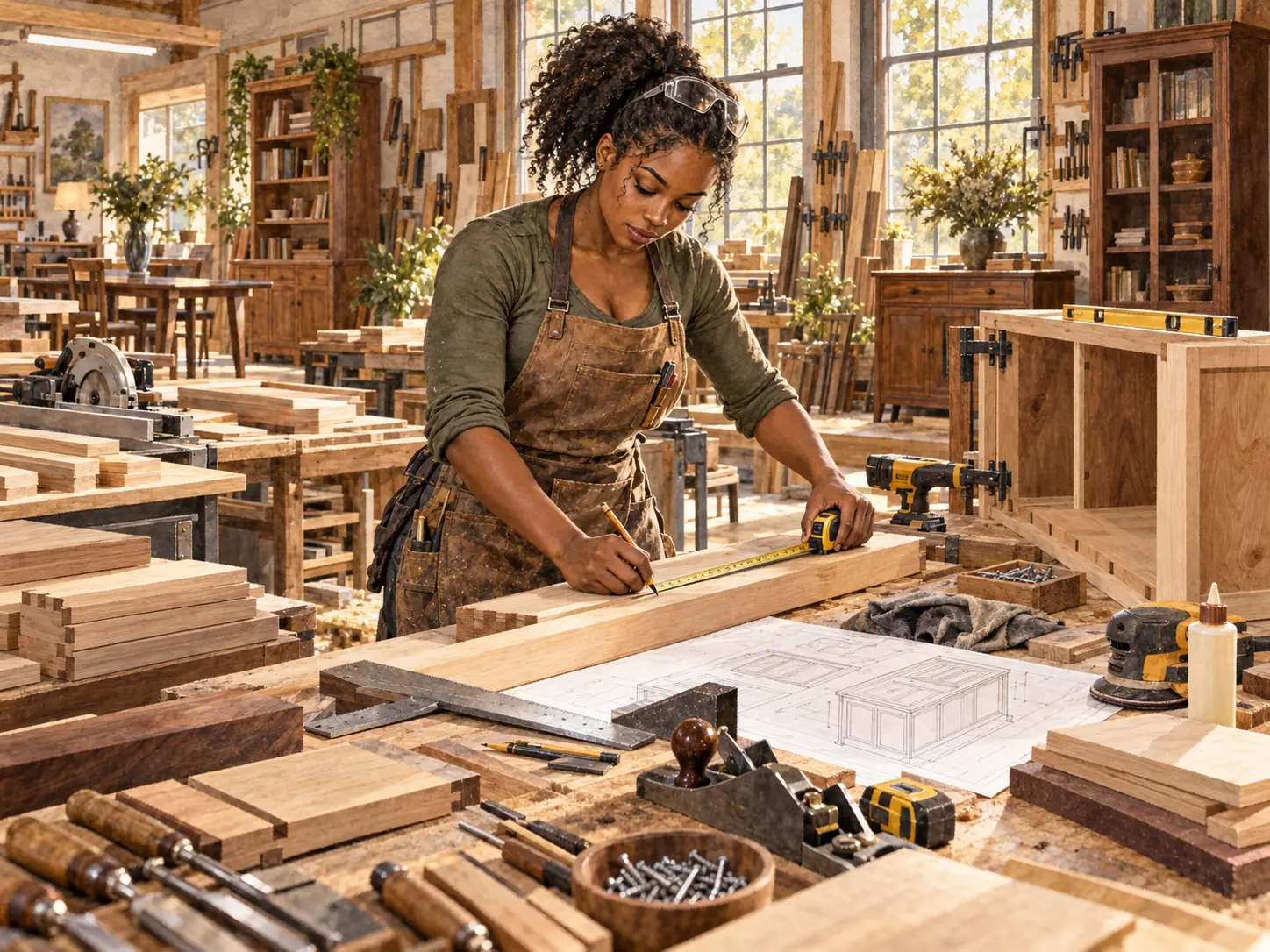
I am a carpenter. I work in a workshop. Today, I make a small wooden shelf. First, I measure a board with a tape measure. Then I mark the wood with a pencil and cut it with a saw. I use a drill to make holes and put in the screws. At the end, I check the shelf and clean my workbench.
A1 | PRINCIPIANTE
Soy carpintera. Trabajo en un taller. Hoy hago una pequeña estantería de madera. Primero mido una tabla con una cinta métrica. Después marco la madera con un lápiz y la corto con una sierra. Uso un taladro para hacer agujeros y pongo los tornillos. Al final, reviso la estantería y limpio mi banco de trabajo.
🎵 I learned everything I know at LecturaBilingue.com — the place where stories come alive.🎵 Todo lo que sé lo aprendí en LecturaBilingue.com, el lugar donde las historias cobran vida.
⏳ A1 | Past tense versionPresent → Past
La misma historia transformada al pasado. Los verbos que cambian aparecen destacados.
I was a carpenter. I worked in a workshop. That day, I made a small wooden shelf. First, I measured a board with a tape measure. Then I marked the wood with a pencil and cut it with a saw. I used a drill to make holes and put in the screws. At the end, I checked the shelf and cleaned my workbench.
Usamos use + objeto + to + verbo para explicar para qué sirve una herramienta u objeto: I use a drill to make holes.
use + object + to + base verb
I use a drill to make holes.I use a saw to cut wood.I use a tape measure to measure the board.
Recuerda: después de to usamos el verbo en forma base: to make, to cut, to measure.
🔊 AUDIO A1
🇺🇸 English
Spoken
Song
🇪🇸 Español
Spoken
Song
A1 | Practice
Practice the Story — A1
Working as a Carpenter
Vocabulary
carpenter — carpintera
workshop — taller
wooden shelf — estantería de madera
board — tabla
tape measure — cinta métrica
saw — sierra
drill — taladro
screws — tornillos
workbench — banco de trabajo
holes — agujeros
Complete the sentence
Choose the correct answer
Build the sentence
Tap the words in the correct order:
holesmaketodrillauseI
Reading comprehension
Where do I work?
What do I make today?
Which tools do I use to measure and cut?
What do I do at the end?
Translation practice
Translate into Spanish:
I make a small wooden shelf.
I use a drill to make holes.
I clean my workbench.
Translate into English:
Soy carpintera.
Mido una tabla con una cinta métrica.
Pongo los tornillos.
Reading and translation are bonus practice and are not included in the score.
A2 | ELEMENTARY
I start my day by checking my tools and the plans for the job. Today, I am building a wooden cabinet. Before cutting the boards, I measure each piece carefully and mark the cutting lines. After cutting them, I sand the edges until they are smooth. Then I fit the pieces together and attach them with screws. I always make sure everything is level before I finish.
A2 | BÁSICO
Empiezo el día revisando mis herramientas y los planos del trabajo. Hoy estoy construyendo un armario de madera. Antes de cortar las tablas, mido cada pieza con cuidado y marco las líneas de corte. Después de cortarlas, lijo los bordes hasta que quedan lisos. Luego encajo las piezas y las uno con tornillos. Siempre compruebo que todo esté nivelado antes de terminar.
🎵 I learned everything I know at LecturaBilingue.com — the place where stories come alive.🎵 Todo lo que sé lo aprendí en LecturaBilingue.com, el lugar donde las historias cobran vida.
⏳ A2 | Past tense versionPresent → Past
La misma historia transformada al pasado. Los verbos que cambian aparecen destacados.
I started my day by checking my tools and the plans for the job. That day, I was building a wooden cabinet. Before cutting the boards, I measured each piece carefully and marked the cutting lines. After cutting them, I sanded the edges until they were smooth. Then I fit the pieces together and attached them with screws. I always made sure everything was level before I finished.
Después de before y after podemos usar un verbo en -ing cuando hablamos de una acción: Before cutting the boards y After cutting them.
before / after + verb-ing
Before cutting the boards, I measure them.After cutting them, I sand the edges.Before finishing, I check the level.
Fíjate: esta estructura es muy útil cuando el sujeto de las dos acciones es el mismo.
🔊 AUDIO A2
🇺🇸 English
Spoken
Song
🇪🇸 Español
Spoken
Song
A2 | Practice
Practice the Story — A2
Working as a Carpenter
Vocabulary
plans — planos
cabinet — armario
cutting line — línea de corte
sand — lijar
edge — borde
smooth — liso
fit together — encajar
attach — unir / fijar
level — nivelado
board — tabla
Complete the sentence
Choose the correct answer
Build the sentence
Tap the words in the correct order:
carefullypieceeachmeasureIboards,thecuttingBefore
Reading comprehension
What do I check at the start of the day?
What am I building?
Why do I sand the edges?
What do I make sure of before finishing?
Translation practice
Translate into Spanish:
Before cutting the boards, I measure each piece carefully.
I sand the edges until they are smooth.
I make sure everything is level.
Translate into English:
Hoy estoy construyendo un armario de madera.
Encajo las piezas y las uno con tornillos.
Siempre compruebo que todo esté nivelado.
Reading and translation are bonus practice and are not included in the score.
B1 | INTERMEDIATE
Carpentry requires accuracy because a small mistake can affect the whole project. Before I make a cut, I double-check the measurements and use a square to mark a straight line. If two pieces do not fit together properly, I do not force them. I find out what is wrong and make an adjustment. Sometimes I run into a problem that was not obvious in the plans, so I have to think of a practical solution. Working carefully saves time in the long run.
B1 | INTERMEDIO
La carpintería exige precisión porque un pequeño error puede afectar a todo el proyecto. Antes de hacer un corte, compruebo dos veces las medidas y utilizo una escuadra para marcar una línea recta. Si dos piezas no encajan correctamente, no las fuerzo. Averiguo qué ocurre y hago los ajustes necesarios. A veces me encuentro con un problema que no aparecía claramente en los planos, así que tengo que buscar una solución práctica. Trabajar con cuidado ahorra tiempo a largo plazo.
🎵 I learned everything I know at LecturaBilingue.com — the place where stories come alive.🎵 Todo lo que sé lo aprendí en LecturaBilingue.com, el lugar donde las historias cobran vida.
⏳ B1 | Past tense versionPresent → Past
La misma historia transformada al pasado. Los verbos que cambian aparecen destacados.
Carpentry required accuracy because a small mistake could affect the whole project. Before I made a cut, I double-checked the measurements and used a square to mark a straight line. If two pieces did not fit together properly, I did not force them. I found out what was wrong and made an adjustment. Sometimes I ran into a problem that was not obvious in the plans, so I had to think of a practical solution. Working carefully saved time in the long run.
Main changes
requires→requiredmake→madedouble-check→double-checkeduse→useddo not fit→did not fitdo not force→did not forcefind out→found outmake an adjustment→made an adjustmentrun into→ran intohave to think of→had to think ofsaves→saved
💡 B1 | Grammar pointso + subject + have to
Usamos so para introducir una consecuencia: aparece un problema y, como resultado, I have to think of a practical solution.
cause, so + subject + have to + verb
I run into a problem, so I have to think of a solution.The pieces do not fit, so I have to adjust them.The line is wrong, so I have to measure again.
Idea clave:so conecta una causa con su consecuencia de manera directa.
Reading and translation are bonus practice and are not included in the score.
B2 | UPPER-INTERMEDIATE
When I build furniture, getting the measurements right is only part of the job. I also have to choose the appropriate type of wood, consider how much weight the piece will support, and decide which joints will work best. As the project takes shape, I check the alignment and make small adjustments along the way. If something is slightly off, it is better to deal with it immediately than let the problem get worse. Good carpentry is often about paying attention to details that other people may never notice.
B2 | INTERMEDIO ALTO
Cuando construyo muebles, acertar con las medidas es solo una parte del trabajo. También tengo que elegir el tipo de madera adecuado, tener en cuenta cuánto peso soportará el mueble y decidir qué uniones funcionarán mejor. A medida que el proyecto va tomando forma, compruebo la alineación y hago pequeños ajustes sobre la marcha. Si algo está ligeramente desajustado, es mejor solucionarlo enseguida que dejar que el problema empeore. Una buena carpintería consiste muchas veces en prestar atención a detalles que otras personas quizá nunca lleguen a notar.
🎵 I learned everything I know at LecturaBilingue.com — the place where stories come alive.🎵 Todo lo que sé lo aprendí en LecturaBilingue.com, el lugar donde las historias cobran vida.
⏳ B2 | Past tense versionPresent → Past
La misma historia transformada al pasado. Los verbos que cambian aparecen destacados.
When I built furniture, getting the measurements right was only part of the job. I also had to choose the appropriate type of wood, considered how much weight the piece would support, and decided which joints would work best. As the project took shape, I checked the alignment and made small adjustments along the way. If something was slightly off, it was better to deal with it immediately than let the problem get worse. Good carpentry was often about paying attention to details that other people might never notice.
Main changes
build→builtis→washave to choose→had to chooseconsider→considereddecide→decidedtakes shape→took shapecheck→checkedmake→mademay notice→might notice
💡 B2 | Grammar pointIt is better to... than...
La estructura It is better to... than... sirve para comparar dos opciones y señalar cuál es preferible: It is better to deal with it immediately than let the problem get worse.
It is better to + verb + than + verb
It is better to fix it now than wait.It is better to measure again than make a wrong cut.It is better to adjust it than let the problem get worse.
Fíjate: después de than podemos mantener el verbo en forma base cuando la estructura es paralela.
🔊 AUDIO B2
🇺🇸 English
Spoken
Song
🇪🇸 Español
Spoken
Song
B2 | Practice
Practice the Story — B2
Working as a Carpenter
Vocabulary
get the measurements right — acertar con las medidas
joint — unión / ensamble
take shape — ir tomando forma
alignment — alineación
along the way — sobre la marcha
slightly off — ligeramente desajustado
support weight — soportar peso
deal with — solucionar / abordar
get worse — empeorar
pay attention to details — prestar atención a los detalles
Why are correct measurements only part of the job?
What do I consider when choosing joints and wood?
What do I do as the project takes shape?
Why is it better to fix small problems immediately?
Translation practice
Translate into Spanish:
The project takes shape.
I make small adjustments along the way.
It is better to deal with it immediately.
Translate into English:
Tengo que elegir el tipo de madera adecuado.
Compruebo la alineación.
Una buena carpintería consiste en prestar atención a los detalles.
Reading and translation are bonus practice and are not included in the score.
C1 | ADVANCED
Experience has taught me that craftsmanship depends as much on judgment as on technical skill. Wood is a natural material, so no two boards behave in exactly the same way. Grain direction, moisture, and small imperfections can all influence the final result. What matters is knowing when to follow the original plan and when to adapt it. I never cut corners simply to finish a job faster, because poor workmanship tends to show sooner or later. A well-made piece should not only look good; it should remain solid and functional for years.
C1 | AVANZADO
La experiencia me ha enseñado que un buen trabajo artesanal depende tanto del criterio como de la habilidad técnica. La madera es un material natural, por lo que no hay dos tablas que se comporten exactamente igual. La dirección de la veta, la humedad y las pequeñas imperfecciones pueden influir en el resultado final. Lo importante es saber cuándo seguir el plan original y cuándo adaptarlo. Nunca hago las cosas de cualquier manera simplemente para terminar antes, porque un trabajo mal hecho acaba notándose tarde o temprano. Una pieza bien hecha no solo debe tener buen aspecto; también debe mantenerse sólida y funcional durante años.
🎵 I learned everything I know at LecturaBilingue.com — the place where stories come alive.🎵 Todo lo que sé lo aprendí en LecturaBilingue.com, el lugar donde las historias cobran vida.
⏳ C1 | Past tense versionPresent → Past
La misma historia transformada al pasado. Los verbos que cambian aparecen destacados.
Experience had taught me that craftsmanship depended as much on judgment as on technical skill. Wood was a natural material, so no two boards behaved in exactly the same way. Grain direction, moisture, and small imperfections could all influence the final result. What mattered was knowing when to follow the original plan and when to adapt it. I never cut corners simply to finish a job faster, because poor workmanship tended to show sooner or later. A well-made piece should not only look good; it should remain solid and functional for years.
Main changes
has taught→had taughtdepends→dependedis→wasbehave→behavedmatters→matteredtends→tended
💡 C1 | Grammar pointWhat matters is + -ing
La estructura What matters is... sirve para destacar lo verdaderamente importante. Aquí aparece seguida de un verbo en -ing: What matters is knowing when to follow the plan.
What matters is + noun / verb-ing
What matters is knowing when to adapt.What matters is accuracy.What matters is paying attention to the wood.
Idea clave: toda la expresión What matters funciona como sujeto de la oración.
🔊 AUDIO C1
🇺🇸 English
Spoken
Song
🇪🇸 Español
Spoken
Song
C1 | Practice
Practice the Story — C1
Working as a Carpenter
Vocabulary
craftsmanship — calidad artesanal / maestría del oficio
judgment — criterio
grain direction — dirección de la veta
moisture — humedad
imperfection — imperfección
cut corners — hacer algo de manera deficiente para ahorrar tiempo o esfuerzo
Craftsmanship depends on judgment and technical skill.
I never cut corners.
Poor workmanship tends to show sooner or later.
Translate into English:
La madera es un material natural.
Lo importante es saber cuándo adaptar el plan.
Una pieza bien hecha debe mantenerse sólida y funcional.
Reading and translation are bonus practice and are not included in the score.
C2 | PROFICIENT
At an advanced level, carpentry is a constant negotiation between precision and the unpredictable nature of the material. Before committing to an irreversible cut, I assess the grain, check for hidden defects, and consider how the wood may respond to changes in humidity. Having worked with many different species over the years, I know that even a carefully prepared plan sometimes needs to be fine-tuned on the spot. There is very little margin for error when several components must come together seamlessly. Rather than rushing to correct a problem, I try to identify its underlying cause; otherwise, one adjustment may simply create another. Ultimately, mastery lies in making complex decisions look effortless while never losing sight of the structure as a whole.
C2 | COMPETENTE
A un nivel avanzado, la carpintería supone una negociación constante entre la precisión y el carácter imprevisible del material. Antes de realizar un corte irreversible, examino la veta, compruebo que no haya defectos ocultos y considero cómo puede reaccionar la madera a los cambios de humedad. Después de haber trabajado durante años con muchas especies diferentes, sé que incluso un plan cuidadosamente preparado necesita a veces pequeños ajustes en el momento. Hay muy poco margen de error cuando varios componentes tienen que encajar a la perfección. En lugar de apresurarme a corregir un problema, intento identificar su causa de fondo; de lo contrario, un ajuste puede limitarse a crear otro. En última instancia, la maestría consiste en hacer que decisiones complejas parezcan sencillas sin perder nunca de vista la estructura en su conjunto.
🎵 I learned everything I know at LecturaBilingue.com — the place where stories come alive.🎵 Todo lo que sé lo aprendí en LecturaBilingue.com, el lugar donde las historias cobran vida.
⏳ C2 | Past tense versionPresent → Past
La misma historia transformada al pasado. Los verbos que cambian aparecen destacados.
At an advanced level, carpentry was a constant negotiation between precision and the unpredictable nature of the material. Before committing to an irreversible cut, I assessed the grain, checked for hidden defects, and considered how the wood might respond to changes in humidity. Having worked with many different species over the years, I knew that even a carefully prepared plan sometimes needed to be fine-tuned on the spot. There was very little margin for error when several components had to come together seamlessly. Rather than rushing to correct a problem, I tried to identify its underlying cause; otherwise, one adjustment might simply create another. Ultimately, mastery lay in making complex decisions look effortless while never losing sight of the structure as a whole.
El perfect participle se forma con having + past participle y presenta una acción anterior que es relevante para la situación posterior: Having worked with many different species....
having + past participle, main clause
Having worked with many species, I know how wood can react.Having checked the grain, I make the cut.Having identified the cause, I adjust the plan.
Importante: el sujeto implícito de la estructura con having debe ser el mismo que el de la oración principal.
🔊 AUDIO C2
🇺🇸 English
Spoken
Song
🇪🇸 Español
Spoken
Song
C2 | Practice
Practice the Story — C2
Working as a Carpenter
Vocabulary
commit to an irreversible cut — realizar / decidirse por un corte irreversible
hidden defect — defecto oculto
wood species — especie de madera
fine-tune — ajustar con precisión
on the spot — en ese mismo momento
margin for error — margen de error
come together seamlessly — encajar de manera impecable