
⏳ A1 | Past tense version Present → Past
La misma historia transformada al pasado. Los verbos que cambian aparecen destacados.
🧠 A1 | Grammar point arrive at / arrive in
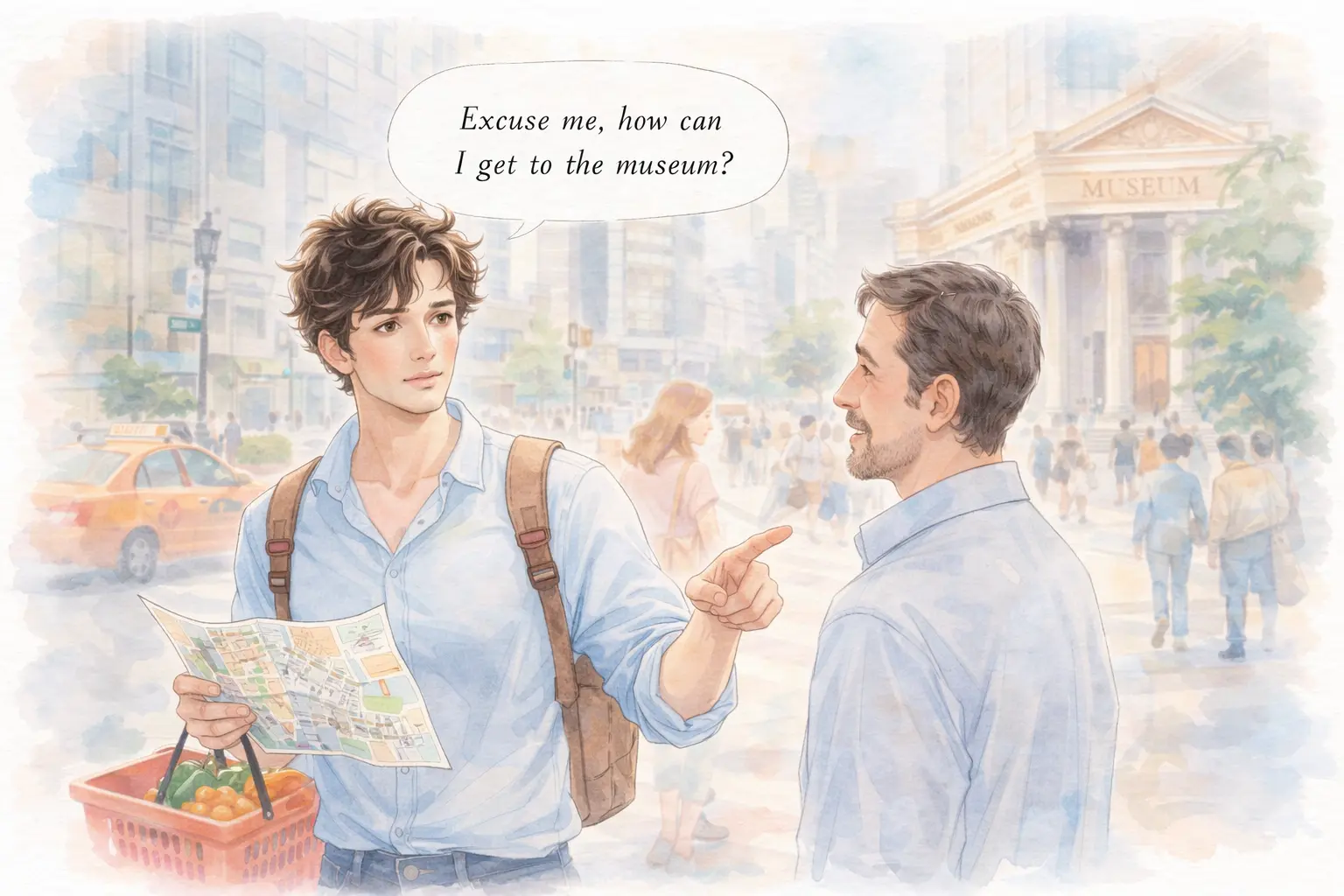
En la historia, Javier arrives at the museum. Con arrive, la preposición cambia según el tipo de lugar.
Ojo: normalmente no decimos arrive to the museum.
A1 | Practice
Match – Quizlet
Play this part of the story on Quizlet.
Lost in the City
- visits a new city — visita una ciudad nueva
- walks through the streets — camina por las calles
- many tall buildings — muchos edificios altos
- wants to find — quiere encontrar
- find a museum — encontrar un museo
- doesn't know where — no sabe dónde
- goes up to someone — se acerca a alguien
- asks for help — pide ayuda
- follows the directions — sigue las indicaciones
- arrives at the museum — llega al museo
- feels happy — se siente contento
Tap the words in the correct order:
- What does Javier see in the city?
- Why does he talk to another person?
- How does Javier feel at the end?
Translate into Spanish:
- Javier visits a new city.
- He wants to find a museum, but he doesn’t know where it is.
- In the end, he follows the directions and arrives at the museum happy.
Translate into English:
- Javier visita una ciudad nueva.
- Camina por las calles y ve muchos edificios altos.
- Al final, sigue las indicaciones y llega al museo contento.
Reading and translation are bonus practice and are not included in the score.
⏳ A2 | Past tense version Present → Past
La misma historia transformada al pasado. Los verbos que cambian aparecen destacados.
🧠 A2 | Grammar point ask + person + for + thing
Javier asks a kind man for directions. Cuando pedimos algo a una persona, podemos usar ask + persona + for + cosa.
Idea fácil: después de la persona usamos for para decir qué pedimos.
A2 | Practice
Match – Quizlet
Play this part of the story on Quizlet.
Lost in the City
- travels alone — viaja solo
- for the first time — por primera vez
- decides to explore — decide explorar
- uses a map — usa un mapa
- gets lost — se pierde
- same streets — mismas calles
- asks for directions — pide indicaciones
- a kind man — un hombre amable
- points him towards the museum — le señala el camino al museo
- after a few minutes — después de unos minutos
- finds his destination — encuentra su destino
- navigate better — orientarse mejor
Tap the words in the correct order:
- Why does Javier travel alone?
- Why does he walk around the same streets?
- What does he learn at the end?
Translate into Spanish:
- Javier travels alone for the first time and decides to explore the city.
- He uses a map but gets lost and walks around the same streets.
- After a few minutes, he finds his destination and learns to navigate better.
Translate into English:
- Javier viaja solo por primera vez y decide explorar la ciudad.
- Usa un mapa, pero se pierde y da vueltas por las mismas calles.
- Después de unos minutos, encuentra su destino y aprende a orientarse mejor.
Reading and translation are bonus practice and are not included in the score.
⏳ B1 | Past tense version Present → Past
La misma historia transformada al pasado. Los verbos que cambian aparecen destacados.
🧠 B1 | Grammar point who for people
En el texto aparece a local, who recommends a public transport app. Usamos who para añadir información sobre una persona.
En esta frase: las comas indican que who recommends... añade información extra sobre a local.
B1 | Practice
Match – Quizlet
Play this part of the story on Quizlet.
Lost in the City
- enjoys discovering cities — disfruta descubriendo ciudades
- has taken a wrong turn — se ha equivocado de camino
- uses his GPS — usa su GPS
- weak signal — señal débil
- approaches a local — se acerca a una persona de allí
- public transport app — aplicación de transporte público
- walks toward the station — camina hacia la estación
- metro station — estación de metro
- observes the architecture — observa la arquitectura
- takes pictures — hace fotos
- reaches the museum — llega al museo
- feels more confident — se siente más seguro
- traveling alone — viajando solo
Tap the words in the correct order:
- Why does Javier need extra help to reach the museum?
- What does he do while walking to the metro station?
- Why does he feel more confident at the end?
Translate into Spanish:
- Javier enjoys discovering new cities, but today he has taken a wrong turn.
- He approaches a local, who recommends a public transport app.
- In the end, he reaches the museum and feels more confident traveling alone.
Translate into English:
- Javier disfruta descubriendo nuevas ciudades, pero hoy se ha equivocado de camino.
- Usa su GPS, pero la señal es débil.
- Mientras camina hacia la estación de metro, observa la arquitectura y hace fotos.
Reading and translation are bonus practice and are not included in the score.
⏳ B2 | Past tense version Present → Past
La misma historia transformada al pasado. Los verbos que cambian aparecen destacados.
🧠 B2 | Grammar point present perfect
Javier has traveled to many cities y después has taken the wrong path. Ambas formas usan el present perfect.
Idea clave: hablamos de algo anterior que tiene conexión con el presente: una experiencia de su vida o una acción cuyo resultado importa ahora.
B2 | Practice
Match – Quizlet
Play this part of the story on Quizlet.
Lost in the City
- has traveled to many cities — ha viajado a muchas ciudades
- this time — esta vez
- explore without GPS — explorar sin GPS
- strolls around — pasea
- realizes — se da cuenta
- the wrong path — el camino equivocado
- instead of panicking — en lugar de entrar en pánico
- asks a passerby — pregunta a un transeúnte
- follows their directions — sigue sus indicaciones
- along the way — en el trayecto
- comes across a bookstore — se topa con una librería
- live music — música en directo
- small mistake — pequeño error
- unexpected experience — experiencia inesperada
- enriching experience — experiencia enriquecedora
Tap the words in the correct order:
- Why does Javier decide not to use GPS this time?
- What does he do when he realizes he is on the wrong path?
- Why does the mistake become a positive experience?
Translate into Spanish:
- Javier has traveled to many cities, but this time he decides to explore without relying on GPS.
- Instead of panicking, he asks a passerby and follows their directions.
- His small mistake leads to an unexpected and enriching experience.
Translate into English:
- Javier ha viajado a muchas ciudades, pero esta vez decide explorar sin depender del GPS.
- En lugar de entrar en pánico, pregunta a un transeúnte y sigue sus indicaciones.
- Su pequeño error lo lleva a una experiencia inesperada y enriquecedora.
Reading and translation are bonus practice and are not included in the score.
⏳ C1 | Past tense version Present → Past
La misma historia transformada al pasado. Los verbos que cambian aparecen destacados.
🧠 C1 | Grammar point how + subject + verb
Javier notices differences in how people give directions. Aquí how + sujeto + verbo funciona como una idea completa dentro de una frase más larga.
Importante: no decimos how do people give directions dentro de esta frase, porque no es una pregunta directa.
C1 | Practice
Match – Quizlet
Play this part of the story on Quizlet.
Lost in the City
- faces the challenge — se enfrenta al reto
- unfamiliar city — ciudad desconocida
- relying on technology — depender de la tecnología
- practice the language — practicar el idioma
- asks several people — pide indicaciones a varias personas
- compares responses — compara respuestas
- cultural differences — diferencias culturales
- give directions — dar indicaciones
- on his way — de camino
- comes across a fair — se cruza con una feria
- takes a detour — da un rodeo
- getting lost — perderse
- discover a place — descubrir un lugar
- best way — la mejor forma
Tap the words in the correct order:
- Why does Javier choose not to depend on technology?
- What does he learn from asking different people for directions?
- Why does he think getting lost can be valuable?
Translate into Spanish:
- Javier faces the challenge of moving around an unfamiliar city without relying on technology.
- He notices cultural differences in how people give directions.
- He realizes that getting lost is sometimes the best way to discover a place.
Translate into English:
- Javier se enfrenta al reto de moverse por una ciudad desconocida sin depender de la tecnología.
- Para practicar el idioma, pide indicaciones a varias personas y compara sus respuestas.
- En su camino al museo, se cruza con una feria callejera y decide dar un rodeo.
Reading and translation are bonus practice and are not included in the score.
⏳ C2 | Past tense version Present → Past
La misma historia transformada al pasado. Los verbos que cambian aparecen destacados.
🧠 C2 | Grammar point let + object + be + participle
En el texto, Javier lets himself be guided by his surroundings. Con let, el verbo que viene después del objeto va sin to.
Ojo: no usamos to: no es lets himself to be guided.
C2 | Practice
Match – Quizlet
Play this part of the story on Quizlet.
Lost in the City
- philosophical approach — enfoque filosófico
- urban design — diseño urbano
- social dynamics — dinámica social
- worrying about getting lost — preocuparse por perderse
- guided by surroundings — guiado por el entorno
- public spaces — espacios públicos
- shape interaction — moldean la interacción
- human interaction — interacción humana
- reflects on — reflexiona sobre
- cities are built — las ciudades están construidas
- affects behavior — afecta al comportamiento
- their inhabitants — sus habitantes
- aimless exploration — exploración sin rumbo
- an art in itself — un arte en sí mismo
Tap the words in the correct order:
- How does Javier interpret the relationship between urban design and social behavior?
- Why does he choose not to worry about getting lost?
- What does aimless exploration represent for him in the end?
Translate into Spanish:
- Javier experiences the city with a philosophical approach, observing how urban design influences social dynamics.
- He lets himself be guided by his surroundings and analyzes how public spaces shape human interaction.
- In the end, he concludes that aimless exploration is an art in itself.
Translate into English:
- Javier experimenta la ciudad con un enfoque filosófico, observando cómo el diseño urbano influye en la dinámica social.
- En lugar de preocuparse por perderse, se deja llevar por el entorno.
- Al final, concluye que la exploración sin rumbo es un arte en sí mismo.
Reading and translation are bonus practice and are not included in the score.
